



Contemporary Living Room Sets: 2026 Buyer's Guide
Last Updated: October 23, 2026
Quick Summary
Contemporary living room sets come in three configurations: a two-piece sofa and loveseat, a multi-piece set with an accent chair or chaise, and a sectional for open plans. Choose the configuration by wall length and traffic flow, then invest in a hardwood frame and tight, high-rub cover.
- Leave 14 to 18 inches between the sofa front and a coffee table so legs can pass.
- Keep at least 30 inches for a main walkway and 36 inches for a primary path.
- A sectional with a chaise needs roughly 12 feet of wall and 8 feet of depth.
- Keep the seating footprint under about 60 percent of the floor area in small spaces.
- A hardwood frame holds its shape while softwood or particleboard sags under daily use.
Table of Contents
- Why Contemporary Living Room Sets Anchor a Room
- What's Included in a Set: Sofas, Loveseats, and Sectionals
- Modern Sectional Sofa Sets Built for Real Rooms
- Sofa and Loveseat Sets: When a Pair Beats a Sectional
- How to Choose a Sofa That Fits Your Layout and Lifestyle
- Living Room Set Ideas for Small Spaces and Open Plans
- Upholstery, Frames, and What You're Really Paying For
- Conclusion
- Frequently Asked Questions
Why Contemporary Living Room Sets Anchor a Room
A living room set is the single largest purchase most homeowners make for their main living space, and it decides how the room functions before a single accent pillow is chosen.
That is the throughline here. Contemporary living room sets work because they remove visual noise. A low, wide seat with a soft neutral cover gives you a base you can layer with color, texture, and art for years without redecorating.
What's Included in a Set: Sofas, Loveseats, and Sectionals
Contemporary living room sets come in three basic configurations, and each solves a different room problem. A two-piece set pairs a sofa with a loveseat, giving you flexible seating you can split across a room. A multi-piece set adds an accent chair or chaise for a complete conversation group. A sectional replaces the pair with one continuous run of seating, usually with a chaise or a curved return.
The choice comes down to wall length and traffic flow. Two-piece sets suit rooms with two facing walls. Sectionals suit open plans where one long wall or a corner needs to carry the seating. We group our own collections this way: the Daiquiri and Between the Sheets sectionals for open spaces, the Bellini Sofa for rooms that need one generous anchor.
Modern Sectional Sofa Sets Built for Real Rooms
Modern sectional sofa sets earn their price when the footprint matches the room, so measure twice. The two we build most often for open-plan living sit at opposite ends of the scale.
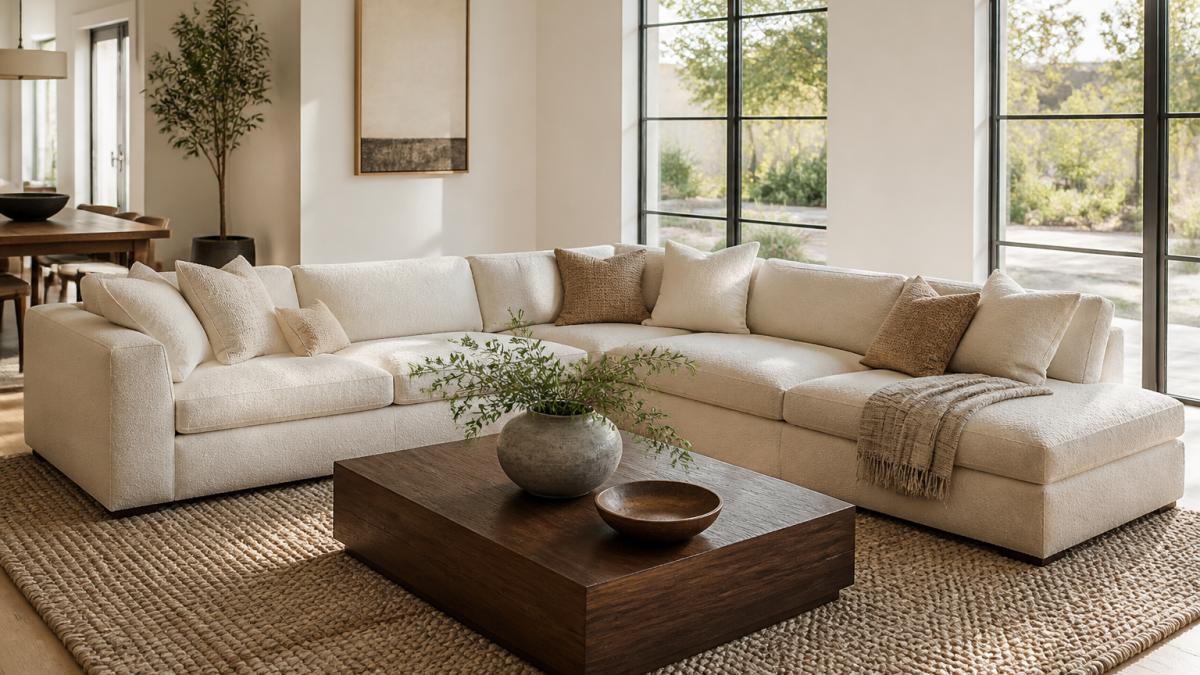
Daiquiri Sectional: Modular Seating That Adapts
The Daiquiri Sectional is the one we recommend when a room's layout might change. Its modular construction lets you set the chaise on the left or right, or reconfigure the whole piece later. At 110 inches wide and 72 inches deep, it seats a crowd without a tall, boxy back blocking sightlines. Soft white upholstery keeps a large piece feeling airy. It costs $5,995, and you can see the Daiquiri Sectional's dimensions and details before you commit.

Between the Sheets Sectional: A Curved Five-Piece Silhouette
Curves solve the problem straight sectionals create: hard corners that chop a room in half. The Between the Sheets Sectional traces a continuous half-circle in oatmeal bouclé, with bolster back cushions and rounded armless ends. At roughly 145 inches wide, it wraps a coffee table on three sides and keeps every seat facing inward. It is $6,495 and currently available to preorder, so view the Between the Sheets Sectional specs and buy options if the curve fits your plan.

Sofa and Loveseat Sets: When a Pair Beats a Sectional
A sofa and loveseat set wins whenever a room has two usable walls and a walkway between them. Pairs let you float a loveseat perpendicular to the sofa, create a reading corner, or split the grouping when guests arrive. They also move through doorways and stairwells far more easily than a 145-inch sectional.
Our Bellini Sofa shows what a single generous piece can do. At 120 inches wide with loose goose-down cushions in off-white Belgian linen, it anchors a large room and pairs naturally with a smaller loveseat or accent chair opposite. For rooms where one wall is short, a pair beats a sectional every time.
How to Choose a Sofa That Fits Your Layout and Lifestyle
Knowing how to choose a sofa starts with four measurements, not one: the wall you plan to fill, the walkway you need to keep clear, the diagonal path from doorway to seating, and the depth of the room from the sofa front to the opposite wall or furniture. Most buyers measure only the first and end up with a piece that blocks traffic or swallows the room.
Here is the working math most designers use. Leave 14 to 18 inches between the sofa front and a coffee table so legs can pass, and keep at least 30 inches for a main walkway and 36 inches for a primary path between facing pieces.
Match the configuration to the room shape before you match it to a style:
- Long, narrow room (under 12 feet wide): a two-piece set against one long wall, or a low-profile sofa with two swivel chairs opposite, keeps the center open.
- Open plan with one long wall: an L-shaped or curved sectional anchors the seating zone and defines the boundary without a wall.
- Square room with two facing walls: a sofa and loveseat pair, floated 30 to 36 inches apart, creates a conversation group that still walks cleanly.
- Small apartment (under 200 square feet of living space): a modular sectional in a light neutral, a slim 36-inch coffee table, and one accent chair beat three competing pieces every time.
Then match the piece to how you actually live. If you are comparing footprints across configurations, our guide to the best sectional sofas for small spaces breaks down which shapes genuinely fit.
One more fit check before you commit: confirm what is actually in the set. A "two-piece set" usually means a sofa plus a loveseat, a "three-piece" adds an accent chair or chaise, and a sectional may ship as three to five modules that count as separate pieces. Ask whether tables, pillows, or a rug are included or sold separately, because a set that looks complete in a photo often is not. That single question resolves most of the confusion shoppers bring to a showroom.
Living Room Set Ideas for Small Spaces and Open Plans
Small spaces reward restraint, but restraint only works when the numbers fit.
For apartments and odd layouts, a modular sectional is the answer because you can adjust the configuration to the walls you actually have.
In open plans, use the sofa's back as a soft room divider rather than adding a wall of shelving.
A few compact configurations that work in real rooms:
- Studio under 400 square feet: one 80- to 90-inch sofa against the long wall, a 36-inch round coffee table, and a pair of nesting side tables instead of a console.
- Narrow row-house living room: a two-piece sofa-and-loveseat set split across facing walls, with a 30-inch walkway between them.
- Open plan with a media wall: a modular sectional with a reversible chaise, floated to define the seating zone while keeping a 36-inch path behind.
If you want a deeper comparison of footprints and configurations, our guide to the best sectional sofas for small spaces breaks down which shapes genuinely fit.
Upholstery, Frames, and What You're Really Paying For
Durability lives in two places: the frame and the cover. A hardwood frame holds its shape for years, while a softwood or particleboard frame sags under daily use. On upholstery, tight, high-rub fabrics resist pilling; loose weaves show wear faster in high-traffic rooms.
This is where price differences actually show up. Buying a set is really buying the materials underneath, and our guide on how to identify high quality furniture walks through what to check before you spend.
| What to Check | Why It Matters | What to Look For |
|---|---|---|
| Frame material | Prevents sagging | Hardwood, kiln-dried joints |
| Cushion fill | Controls comfort and shape | High-resilience foam, down wrap |
| Cover rub count | Predicts wear | Tight weaves for high traffic |
| Seat depth | Decides lounging comfort | 25 inches or more for reclining |
| Configuration | Determines fit | Modular or reversible chaise |
Conclusion
The hardest part of buying contemporary living room sets is not choosing a style, it is committing to a footprint and a frame you will still be happy with in ten years. Start with measurements, choose a configuration that matches your walls, then invest in the frame and cover rather than the trend.
That is how we build at Tom Collins Home: handcrafted pieces designed in Southern California, inspired by the classics, and built to last. If you want to understand what that means in practice, read about why choose California made furniture, then get updated when new pieces arrive.
Frequently Asked Questions
What furniture is included in a contemporary living room set?
A set typically centers on one large seating piece, either a sectional or a sofa, and may pair it with a loveseat, accent chairs, and occasionally a coffee table or TV unit. Tom Collins Home sells seating as individual pieces, so you build the set yourself: a Daiquiri Sectional at $5,995 or a Bellini Sofa at $4,695 form the anchor, then you add accent seating and tables to complete the room. Confirm what each listing includes before ordering, since configurations vary by piece.
How do I choose the right size sofa for my living room?
Measure the wall the sofa will sit against and leave at least 30 inches of walkway around it. For a sectional, also measure the depth of the return arm so it doesn't block a doorway or traffic path. A piece like the Overture Sectional at 168 inches wide needs a genuinely large room, while the Daiquiri Sectional at 110 inches wide suits a mid-size living area. Tape the footprint on the floor before you buy to confirm the scale works.
What is the difference between modern and contemporary furniture?
Modern usually refers to mid-century design principles: clean lines, low profiles, and honest materials. Contemporary describes what is being designed now, which often means curved silhouettes, textured upholstery like bouclé, and warmer neutral palettes. In practice, contemporary living room sets blend both, pairing sleek frames with soft, sculptural shapes. The Chameleon Sectional's S-curve and the French 75's tufted cream linen both sit firmly in the contemporary camp.
Are living room furniture sets a good value compared with buying pieces separately?
Buying a coordinated set usually costs less than sourcing each piece individually, and it removes the guesswork of matching scale, finish, and upholstery. The trade-off is flexibility: a set locks you into one look. A middle path is to anchor the room with one statement piece, such as the Apricot Sour Sectional at $4,695, then add accent chairs and tables over time. That keeps the budget spread out while the room still reads as intentional.
How can I style a contemporary living room set without it feeling cold?
Layer texture rather than color. A cream or oatmeal base like the Between the Sheets Sectional gives you room to add a chunky knit throw, a vintage rug, and a mix of pillow sizes in tonal shades. Add one warm wood or stone element, such as a live-edge coffee table, to break up the upholstery. Keep the palette to three tones and let the shapes do the work. The result reads curated rather than showroom-sterile.
Your living room should feel finished the day the sofa lands, not three redesigns later. Tom Collins Home builds handcrafted luxury furniture with hardwood frames, hand-finished upholstery, and cocktail-inspired silhouettes designed to stay in style. Explore the collection and get updated on new arrivals so your next set is the last one you need to buy.


