



Best Sectional Sofas for Small Spaces in 2026
Table of Contents
- Why Sectional Sofas Work in Small Living Rooms
- How to Measure for a Sectional Before You Buy
- Modular Sectional Sofas for Small Spaces: Top Picks
- Choosing the Right Fabric: Durability, Pets, and Performance
- Comfort, Cushion Density, and Ergonomic Support
- Styling a Small Living Room with a Sectional
- Conclusion
Last Updated: August 22, 2026
The best sectional sofas for small spaces solve a problem most apartment dwellers assume is unsolvable: getting the comfort and visual anchor of a full sectional without sacrificing the room itself. At Tom Collins Home, we've evaluated what separates a sectional that works in a compact living room from one that overwhelms it. The answer comes down to modular design, precise measurements, and durable fabrics. Below, we break down exactly how to find the right fit, with top picks across a range of styles and budgets.
Quick Picks:
- Best Overall: Albany Park Kova L-Shape + Ottoman, plush modular design with fast assembly
- Best for Versatility: Burrow Range 4-Piece Open Sectional, tool-free, stain-resistant, endlessly reconfigurable
- Best Customization: Allform 3-Seat Sofa with Chaise, lifetime frame warranty, reversible chaise
- Best Minimalist Design: Castlery Jonathan Small Sectional, clean architectural lines, genuine modularity
- Best Sleeper Option: Apt2B Tuxedo 2-Piece Sleeper Sectional, queen memory foam mattress built in
- Best Deep Seating: Joybird Holt Sectional, 28-inch seat depth, solid wood frame
Why Sectional Sofas Work in Small Living Rooms
A well-chosen sectional consolidates seating into one cohesive piece, eliminating visual clutter and making a room feel intentional rather than cramped. The key is proportionality: apartment-sized sectionals with compact footprints and low-profile designs keep sight lines open. A corner sectional tucks neatly into walls and directs traffic toward the room's center rather than blocking it.
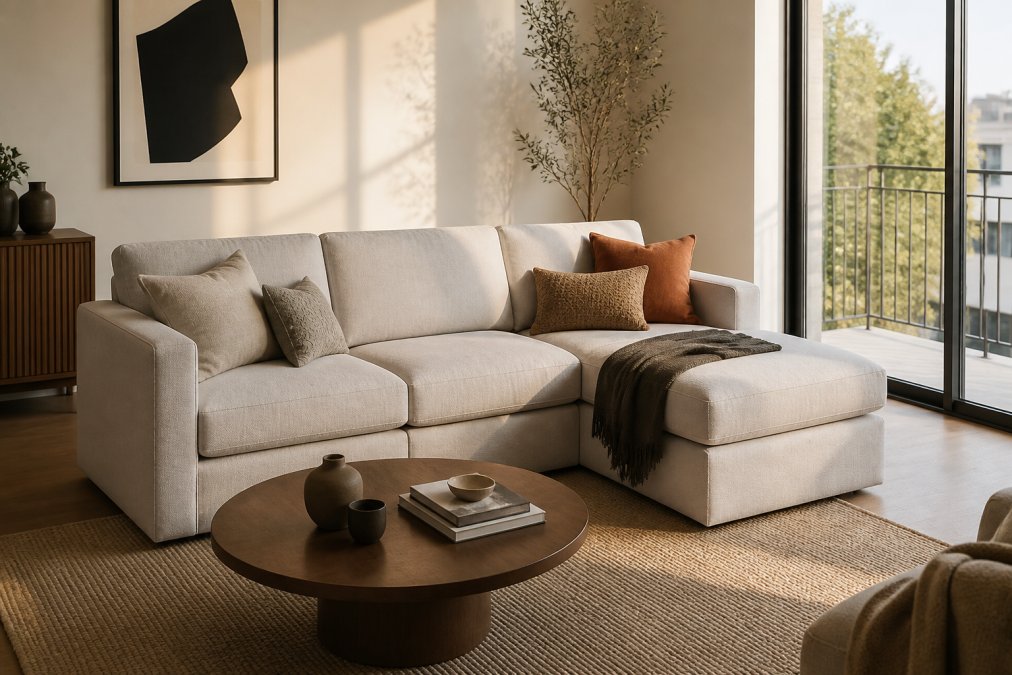
Modular sectional sofas offer additional advantages. Because they ship in separate pieces, they navigate narrow hallways and tight stairwells that would stop a traditional sofa. You can adjust configurations as your space or needs change without buying new furniture.
Ergonomic support matters as much as aesthetics. A sectional you cannot sit in comfortably for two hours is not a good sectional, regardless of how well it fits on paper.
How to Measure for a Sectional Before You Buy
Measuring correctly prevents most returns. You need three measurements: the room itself, the doorways and hallways the sofa must pass through, and the sofa's assembled dimensions.
Start by measuring the full length and width of your room, then mark where you want the sectional using painter's tape on the floor. Walk around the taped outline and confirm you have at least 18 inches of clearance between the sectional and any adjacent wall or furniture for comfortable traffic flow.
Next, measure every doorway, hallway, and stairwell the sofa must pass through. Pay attention to ceiling height on stairwells and 90-degree turns. Modular sectionals that ship in multiple smaller boxes are dramatically easier to maneuver than single-frame sofas.
Finally, confirm the sofa dimensions against your tape outline. Check both the overall footprint and seat depth. A sectional with a 38-inch seat depth will consume meaningfully more floor space than one at 28 inches.
Traffic Flow and Floor Plan Visualization
Leave at least 36 inches between the sofa and any walkway to another room, and 18 inches between the sofa and the coffee table. For L-shaped sectionals, position the chaise end against the wall with the least foot traffic. Sketch your floor plan before committing using free tools from Apartment Therapy's room planning guides.
Modular Sectional Sofas for Small Spaces: Top Picks
These six sectionals were selected for their compact footprint, modular design flexibility, upholstery durability, and real-world suitability for apartment living.
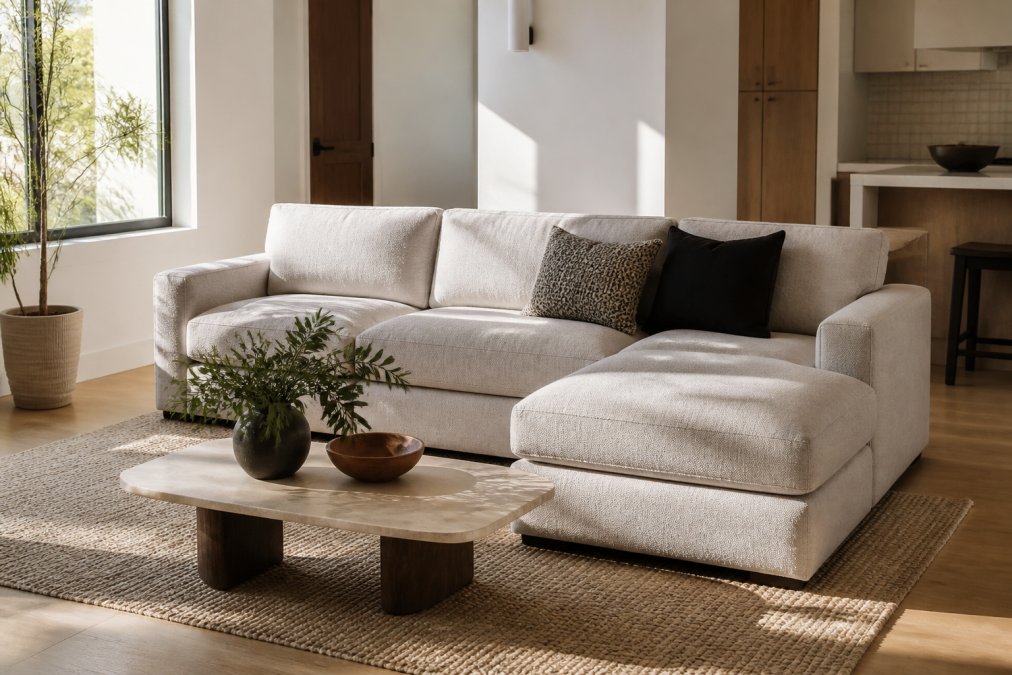
1. Albany Park Kova L-Shape + Ottoman
The Kova offers deep, plush seating without sacrificing flexibility. Its modular design allows easy reconfiguration, and the hypoallergenic, 100% vegan cushion fill delivers genuine comfort. Assembly takes around 30 minutes, and the sectional ships in recyclable boxes sized for standard apartment hallways. Fabric options include velvet and boucle styles.
Some users report that connector hardware requires significant force to seat properly, and cushion sliding can occur on smooth floors.
Best for: Buyers who prioritize plush comfort and want a modular sectional that can expand or reconfigure as their space changes.
| Feature | Detail |
|---|---|
| Design | L-shape with ottoman, modular |
| Cushion Fill | Hypoallergenic vegan fill |
| Assembly | ~30 minutes, no tools required |
| Fabric Options | Velvet, boucle, multiple colors |
| Starting Price | $3,257 (on sale from $5,010) |
2. Burrow Range 4-Piece Open Sectional Double Lounger
Burrow built this sectional around tool-free assembly and a modular system that allows individual modules to be added, removed, or reconfigured. The low-to-the-ground profile and wide arms give it a Scandinavian aesthetic that reads as spacious. Stain-resistant fabrics genuinely hold up against everyday household use, including pets and children.
The tradeoff is back support. The low back works for lounging but requires additional pillows for extended upright sitting.
Best for: Renters, families with pets or children, and anyone who values reconfigurable design without tools.
3. Allform 3-Seat Sofa with Chaise
Allform's primary differentiator is its lifetime warranty on the kiln-dried laminated hardwood frame. The reversible chaise can be positioned on either end, making this one of the most layout-flexible options. Performance-grade fabrics and durable leathers are available across multiple colors. The 100-day home trial with free shipping and returns removes most risk from ordering sight unseen.
There is no white glove delivery service, so you are responsible for getting it from the door to the room.
Best for: Buyers focused on long-term durability and who want the flexibility of a reversible chaise without committing to a fixed configuration.
4. Castlery Jonathan Small Sectional
The Jonathan is ideal for minimalists. Its boxy silhouette and flange seam detail give it architectural presence without visual weight. The modular design allows genuine rearrangement. Deep, comfortable seating and wide armrests make it functional as well as good-looking. Performance fabric and leather options are available.
Fixed covers mean spot-cleaning only, which is a consideration for households with young children or pets. The low back is comfortable for lounging but less so for upright work.
Best for: Design-focused buyers in smaller spaces who want a sectional that looks intentional when empty or occupied.
5. Joybird Holt Sectional
The Holt has a 28-inch seat depth, exceptional for movie nights and extended lounging. Solid wood construction with fortified corners supports long-term durability, and cushions maintain their shape over time. Built-in ottoman storage is practical for small spaces. Customization includes 76 fabric and color choices with chaise orientation options on both sides.
Fabric may pill over time, particularly in chenille. The chaise is not physically connected to the main seating unit, requiring periodic readjustment.
Best for: Buyers who prioritize deep, comfortable seating for relaxation and want storage built into the sectional footprint.
6. Apt2B Tuxedo 2-Piece Sleeper Sectional
The Tuxedo solves a specific problem: small living rooms that need to accommodate overnight guests. The queen-size, 4.5-inch thick memory foam mattress eliminates the need for a separate guest bed, saving meaningful square footage in compact apartments. Custom made in the USA with solid wood frame and eco-friendly construction, it is conscientiously built. Zippered, removable cushion covers simplify cleaning.
Lead and shipping times can run long, so plan accordingly if working toward a move-in date.
Best for: Studio and one-bedroom apartment dwellers who need a sectional that doubles as a guest bed without sacrificing daytime comfort.
Choosing the Right Fabric: Durability, Pets, and Performance
Fabric choice determines whether your sectional holds up to your actual household. Performance fabric has become the standard for upholstery designed to resist staining, moisture, and everyday wear. According to the American Home Furnishings Alliance's fabric care guidelines, performance fabrics use tightly woven synthetic fibers or treated natural fibers that repel liquid rather than absorbing it. For most households, performance fabric is the correct default.
Velvet and boucle options offer richer aesthetics but require more maintenance and suit lower-traffic spaces without pets.
Pet-Friendly Fabric Deep-Dive
Pet ownership changes the fabric calculus significantly. For scratching, tightly woven fabrics with high thread counts resist claw damage better than loosely woven textiles. Leather and performance fabric outperform natural weaves. Avoid boucle entirely if you have cats.
For hair embedding, smooth performance fabrics and leather release pet hair easily with a lint roller or damp cloth. Velvet and chenille trap hair at the fiber level, making cleaning difficult.
For odor absorption, removable and washable covers are the most practical solution. The Apt2B Tuxedo's zippered removable covers address this directly.
Comfort, Cushion Density, and Ergonomic Support
Cushion density is the specification most retailers underreport, yet it is one of the most important factors in long-term satisfaction. Low-density foam feels plush initially but sags within 18 months. Higher-density foam feels firmer but holds its shape for years.
The best sectional sofas balance cushion firmness with ergonomic support across different seating positions. Deep seats like the Joybird Holt's 28-inch depth excel for lounging but can create lower back strain for upright sitting without compensating back cushions. Shallower seat depths, typically 22 to 26 inches, suit a broader range of postures and body types.
According to ergonomic seating research from Cornell University's Human Factors and Ergonomics Research Group, proper seated posture requires that the seat depth allows the user to sit fully back with a few inches of clearance behind the knees. For most adults, that means a seat depth between 20 and 22 inches for upright seating.
Low-profile designs with tapered legs allow light to pass beneath the sofa, visually expanding the room. Sofas that sit directly on the floor tend to make small rooms feel heavier and more enclosed.
Styling a Small Living Room with a Sectional
Floating a sectional slightly away from the wall creates a sense of depth and makes the room feel larger, not smaller. An area rug anchors the sectional and defines the seating zone. Choose a rug large enough that at least the front legs rest on it.
Lighter upholstery colors and low-profile designs with tapered legs keep the room feeling open. A large mirror on the adjacent wall amplifies natural light and creates the illusion of additional depth.
Reversible Chaise Configurations and Layout Options
The reversible chaise is one of the most underappreciated features in apartment living. It means you are not locked into a single configuration when you move, redecorate, or realize the original layout does not work.
For L-shaped sectionals, position the chaise end toward the wall with the least foot traffic, and orient the open end toward the room's entry point. For open-plan apartments, a corner sectional with the chaise tucked into the corner creates a natural visual boundary between zones without requiring a physical divider.
The modular sectional designs from Allform, Burrow, and Castlery all support this kind of reconfiguration. The Allform chaise in particular can be repositioned on either end without additional hardware.
| Sectional | Best For | Seat Depth | Key Fabric Options | Reversible Chaise | Starting Price |
|---|---|---|---|---|---|
| Albany Park Kova | Plush lounging, modular flexibility | Deep | Velvet, boucle, performance | No | $3,257 |
| Burrow Range 4-Piece | Renters, pet households | Deep | Stain-resistant performance | Yes (modular) | $2,543 |
| Allform 3-Seat with Chaise | Long-term durability, customization | Medium-deep | Performance, leather | Yes | $3,511 |
| Castlery Jonathan | Minimalist design, small spaces | Deep | Performance fabric, leather | No | $3,039 |
| Joybird Holt | Deep comfort, storage | 28 inches | 76 fabric/color options | Yes | $4,421 |
| Apt2B Tuxedo Sleeper | Guest accommodation, studio living | Deep | Hypoallergenic, removable covers | No | ~$3,000 |
Finding the best sectional sofas for small spaces requires balancing dimensions, fabric durability, and configuration flexibility. Tom Collins Home designs handcrafted sectionals and sofas built for exactly this kind of considered, long-term purchase. Our pieces are designed in Southern California with timeless proportions and exceptional craftsmanship, built to hold their shape and character for years rather than seasons. If you are ready to invest in a sectional that will anchor your living room for the long term, explore the Tom Collins Home collection and find the configuration that fits your space.
Frequently Asked Questions
Are sectional sofas actually good for small rooms?
Yes, when sized correctly. A sectional sofa with a compact footprint can replace a sofa-plus-armchair combination, consolidating seating into one piece and freeing up floor space. The key is choosing an apartment-sized sectional with a low-profile design and ensuring at least 36 inches of clearance for traffic flow around the piece. Modular sectional sofas for small spaces are especially practical because you can remove a module if the layout shifts.
How do you measure a sectional for a small living room?
Start by measuring the full length of each wall the sectional will run along, then mark the sofa dimensions on the floor with painter's tape before ordering. Account for the chaise length separately, and leave at least 18 inches between the sectional and any coffee table. Check doorway and hallway widths too, most sectionals ship in multiple boxes, but individual modules still need to clear tight corners. Confirm seat depth, overall height, and floor clearance against your room's proportions.
What couch style works best for small spaces?
An L-shaped or chaise sectional with a low-profile design and tapered legs tends to work best. The raised legs create visual floor clearance, making the room feel larger. Avoid deep, overstuffed frames in rooms under roughly 12 by 14 feet. A two-piece sectional with a reversible chaise gives you the most layout flexibility, since you can flip the chaise to whichever side suits your living room layout as needs change.
Which sectional sofa holds up best over time?
Frame construction is the deciding factor for long-term durability. Look for kiln-dried hardwood frames with corner-blocked joints rather than particleboard or metal frames prone to flex. High-density foam cushions rated above 1.8 pounds per cubic foot resist sagging longer than standard foam. Performance fabric with stain resistance and removable covers adds years of practical life, especially in households with pets or children. Lifetime frame warranties, like the one Allform offers, signal genuine confidence in construction quality.
Can a sectional sofa work in an oddly shaped or rental living room?
Modular sectional sofas handle irregular layouts better than fixed-frame pieces because you can add, remove, or reposition individual modules. For rental spaces with unusual wall angles or limited square footage, a two- or three-piece modular sectional with a reversible chaise gives you the most configuration options without requiring permanent installation. Always use painter's tape to map the sectional configuration on your floor before committing to a purchase.
This article was written using GrandRanker


