



9 Sustainable Materials for Modern Dining Furniture
Last Updated: November 25, 2026
Quick Summary
Sustainable materials for modern dining furniture are natural or recycled materials sourced, processed, and finished to limit environmental harm while keeping the piece in use for decades. We judge every option on sourcing, durability, repairability, finishes and adhesives, and end of life, because the greenest table is the one you never replace.
- Solid hardwood is strong, repairable, and ages into character rather than decay, making it the benchmark for sustainable wood.
- A reclaimed wood dining table fells no new tree, but salvaged timber can arrive with old nails and hidden cracks.
- Bamboo matures in a handful of years, yet strand-woven panels are bonded with adhesives that decide performance and emissions.
- Tempered glass resists thermal shock but cannot be sanded or refinished, so a deep scratch means replacement.
- Ask whether a piece holds UL GREENGUARD certification, which sets emission limits for furniture and building products.
Table of Contents
- What Makes Dining Furniture Materials Sustainable
- Sustainable Wood for Furniture: Solid Ash, Walnut, and Hardwood
- Reclaimed Wood Dining Table: Character With a Smaller Footprint
- Bamboo, Cork, and Other Rapidly Renewable Materials
- Recycled Metal, Glass, and Terrazzo in Modern Dining Sets
- GREENGUARD Gold Certified Dining Table: Finishes, Adhesives, and Indoor Air
- Material Comparison: Durability, Repairability, and End of Life
- Choosing Your Sustainable Dining Table at Tom Collins Home
- Frequently Asked Questions
What Makes Dining Furniture Materials Sustainable
Sustainable materials for modern dining furniture are natural or recycled materials sourced, processed, and finished in ways that limit environmental harm while keeping the piece in use for decades, and we judge every sustainable materials option on the same four criteria.
Most buying guides stop at "reclaimed is good, new wood is bad." That framing misses the point. A responsibly harvested solid hardwood table that lasts forty years usually carries a lighter footprint than a fast-made composite piece replaced twice a decade. Durability is the quietest form of sustainability.
The Criteria That Actually Matter
Sustainable materials can be judged against five questions:
- Sourcing: Is the timber certified or reclaimed, and can the supplier prove it?
- Durability: Will the surface survive daily meals, hot dishes, and children's homework?
- Repairability: Can a scratch be sanded out, or does the whole top need replacing?
- Finishes and adhesives: Do the coatings and glues release harmful fumes indoors?
- End of life: Can the material be recycled, refinished, or composted?
A material that scores well on all five tends to be the one you keep.
Sustainable Wood for Furniture: Solid Ash, Walnut, and Hardwood
Solid hardwood is the benchmark for sustainable wood for furniture, and for good reason: it is strong, repairable, and ages into character rather than decay. Ash and walnut sit at the top of our list. Ash is pale, springy, and takes a finish beautifully.
Look for timber from forests managed under a credible certification program. The Forest Stewardship Council's certification standards set requirements for responsible forestry, including replanting and protecting wildlife habitat. Ask any maker where their wood comes from and whether they can show certification.
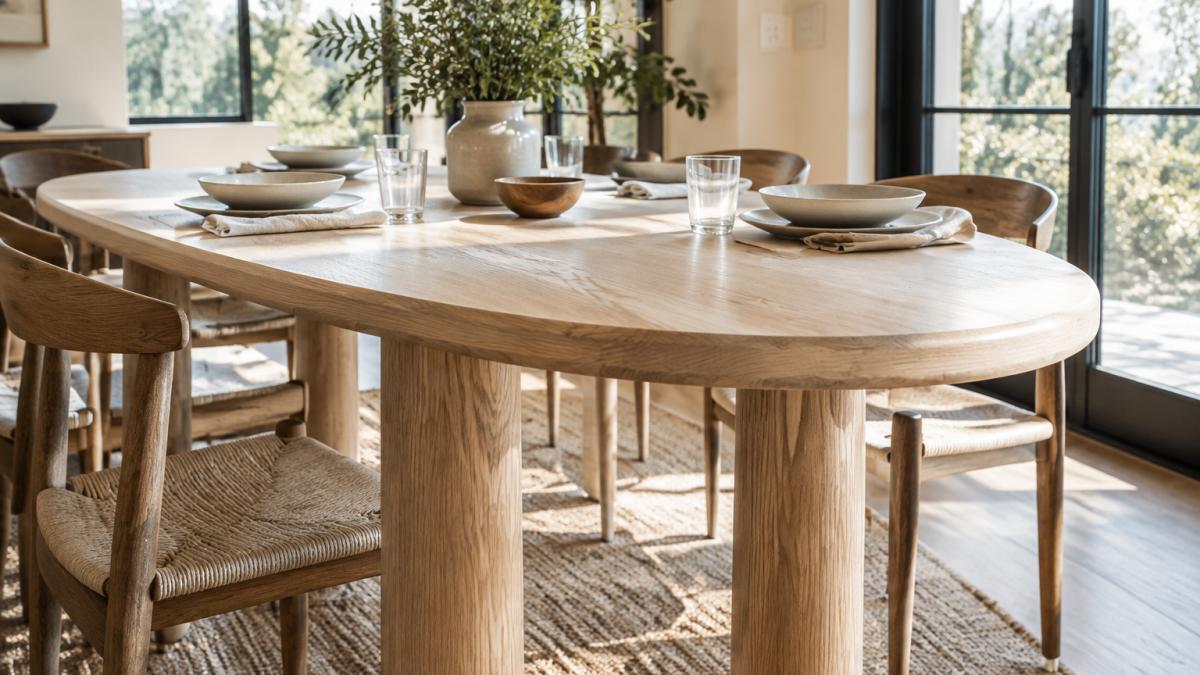
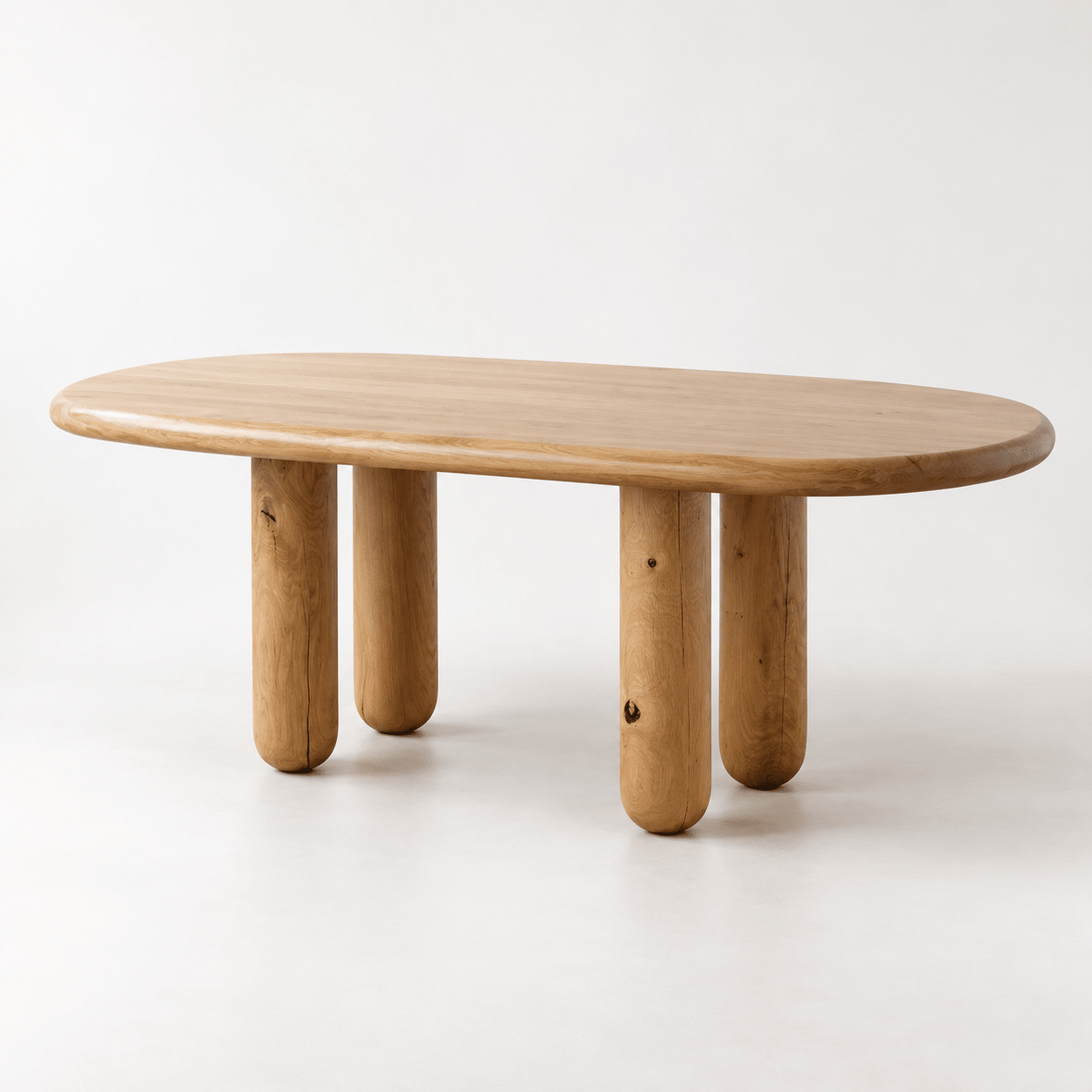
The Hot Toddy Oval Dining Table is built from solid ash throughout, with a warm, honey-toned natural finish and four rounded log legs. If you want to see how that construction looks in a real piece, explore the Hot Toddy Oval Dining Table in solid ash.
Why Solid Wood Outlasts Veneer and Composite
Veneer is a thin slice of real wood glued over particleboard or MDF. It looks convincing in a showroom and fails in a kitchen. Once moisture reaches the core, the board swells, the veneer lifts, and the top cannot be sanded or refinished. That difference in lifespan is the whole sustainability argument in one sentence: the greenest table is the one you never replace. We go deeper on this in our guide to why solid wood furniture lasts longer.
Reclaimed Wood Dining Table: Character With a Smaller Footprint
A reclaimed wood dining table is made from timber salvaged from old barns, factories, and bridges, then cleaned, milled, and refinished. The material is already grown, so no new tree is felled to produce it. Every reclaimed board carries a history, which is why these tables tend to have the most distinctive grain and color variation of any option.
The trade-offs are real. Salvaged timber can arrive with old nails, hidden cracks, and inconsistent dimensions, so the maker's skill matters more than with new stock. Expect a heavier piece and a finish that may need more frequent oiling. Where reclaimed wins is character and resource conservation: you are reusing material that would otherwise be landfill.
Best for: buyers who want a one-of-a-kind table and a story behind it. Skip if: you need perfectly uniform color across a large top.
Bamboo, Cork, and Other Rapidly Renewable Materials
Bamboo and cork are the fastest-renewing options on this list. Bamboo is a grass, not a tree, and matures in a handful of years rather than decades. Cork is harvested from the bark of living cork oaks, which regrow their outer layer and are not cut down in the process. Both count as renewable resources in the truest sense.
What most guides miss is that "renewable" does not automatically mean "durable." Bamboo used in furniture is usually strand-woven and bonded with adhesives, and the quality of that adhesive decides how the panel performs and what it off-gasses. Cork is soft and warm underfoot but dents under heavy loads, so it suits side pieces better than a main dining surface. These materials are worth considering, but read the binder and finish details before you commit.
Recycled Metal, Glass, and Terrazzo in Modern Dining Sets
Recycled materials bring texture and contrast to a dining room, and they keep industrial waste in circulation rather than in landfill. But a dining set is more than a top and a base.
Start with the frame. Stainless steel is among the most recycled metals in the world, and recycled-content steel and aluminum are common in modern chair frames and table bases.
Glass is the next layer. Recycled glass tops and glass-fiber-reinforced composite seats turn post-consumer content into surfaces with real visual punch.
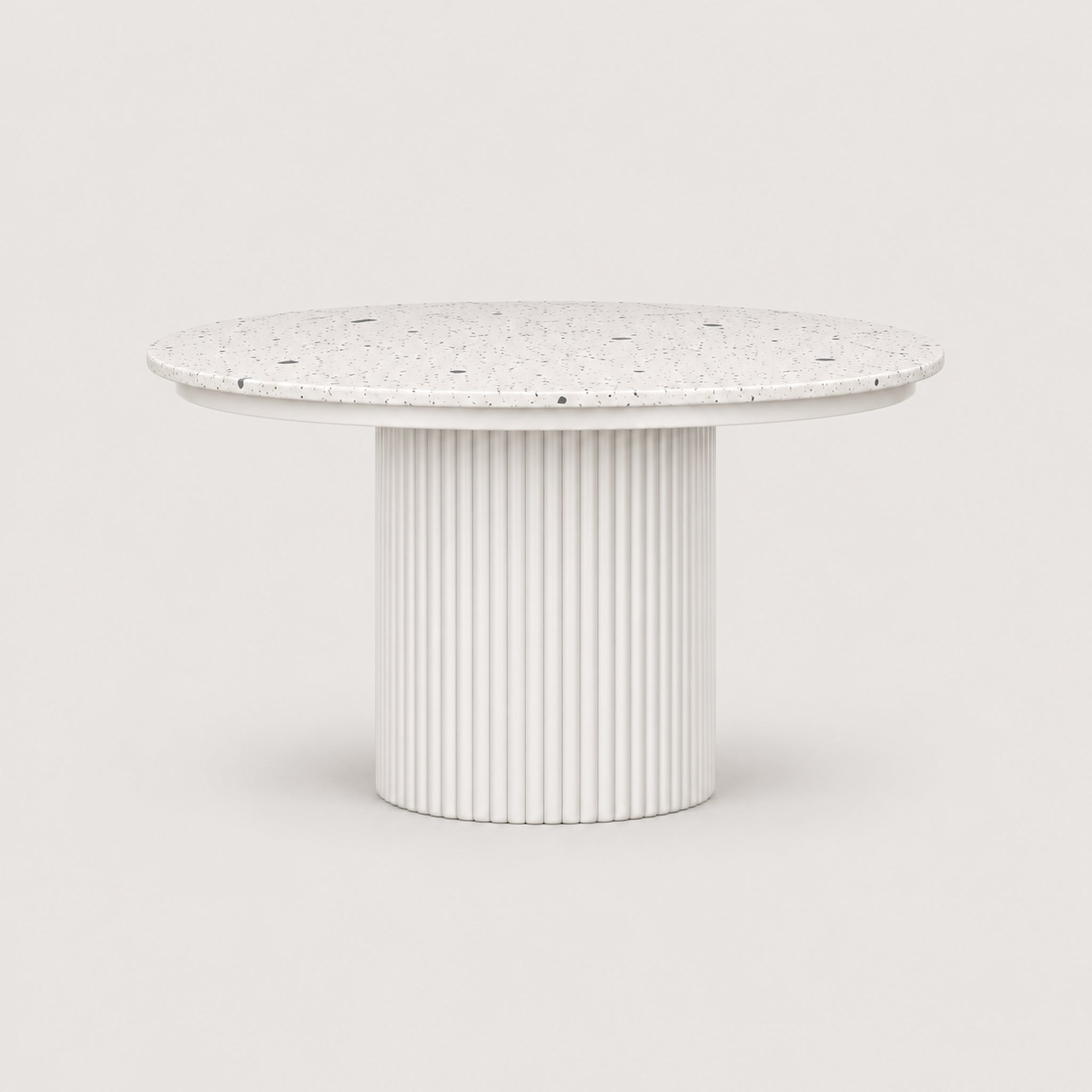
Terrazzo deserves its own note. Our White Terrazzo Round Dining Table pairs a terrazzo top flecked with black and gray chips with a fluted pedestal base, and you can view the terrazzo round dining table to see the material up close.
Upholstery is where recycled content gets complicated. Recycled polyester and solution-dyed fabrics are common on modern dining chairs, and some brands offer fabrics made from post-consumer plastic bottles.
Hardware is small but not trivial. Recycled-content zinc and aluminum castings are common in chair frames and table mechanisms, and they are highly recyclable at end of life.
Watch out: a "recycled" label on a chair or table says nothing about the binder, the finish, or whether the piece can be repaired, so treat recycled content as one input among several rather than proof of sustainability.
GREENGUARD Gold Certified Dining Table: Finishes, Adhesives, and Indoor Air
A A solid wood top is only as clean as what coats it. Solvent-heavy lacquers and cheap glues can release volatile organic compounds into your home for months.
This is the angle almost every competitor skips. When you shop, ask three questions: what finish is on the top, what adhesive holds any joined components, and is there third-party certification for emissions? The UL GREENGUARD certification program sets emission limits for furniture and building products, so a certified piece gives you a verifiable answer rather than a marketing claim. For a deeper look at coatings that hold up to daily use, read our guide to the best wood finishes for high-traffic dining tables.
Material Comparison: Durability, Repairability, and End of Life
Here is how the main options stack up against the criteria that matter. We weight repairability heavily, because a table you can refinish is a table you keep.
| Material | Durability | Repairability | Recycled/Renewable | End of Life | Embodied-Carbon Note |
|---|---|---|---|---|---|
| Solid hardwood | High | Sand and refinish | Renewable, certified | Reusable, compostable | Lower if certified and local; higher if kiln-dried with fossil fuels and shipped far |
| Reclaimed wood | High | Sand and refinish | Reused material | Reusable | Avoids new harvest but may carry transport and de-nailing energy |
| Bamboo | Medium | Limited sanding | Rapidly renewable | Often compostable | Adhesive-heavy panels can offset renewability gains |
| Cork | Low to medium | Difficult | Renewable bark | Biodegradable | Low-impact harvest, but binders and transport matter |
| Recycled metal | High | Polish or recoat | High recycled content | Highly recyclable | Recycling saves energy versus virgin ore, but smelting is energy-intensive |
| Terrazzo | High | Patch and polish | Recycled chips | Recyclable | Binder choice (cement vs. resin) drives most of the impact |
| Recycled glass | Medium | Replace panel | High recycled content | Recyclable | Melting recycled glass saves energy versus virgin batch |
The pattern is clear: solid and reclaimed wood win on repairability, metal and terrazzo win on recyclability, and bamboo and cork trade lifespan for renewability.
But the table hides the trade-offs that decide whether a material label means anything.
Lifecycle thinking is the missing layer in most buying guides. Instead of asking "is this material green?", compare options across five stages: extraction or harvest, manufacturing, transport, use, and end of life.
Verification is the practical step readers can take. For emissions, look for third-party certification such as the UL GREENGUARD certification program, which sets emission limits for furniture and building products.
Watch out: a material can score well on renewability and poorly on repairability, or vice versa, so do not let one strong column in a comparison table stand in for the whole lifecycle.
Choosing Your Sustainable Dining Table at Tom Collins Home
Choosing well comes down to three moves: verify the sourcing, check the finish and adhesive, and pick a material you can maintain for decades. A table is a long commitment, and the sustainable choice is almost always the repairable one. If you want to see the full range, browse the Hot Toddy Oval Dining Table and picture it in your own dining room.
The real test of a sustainable dining table is not the label on the showroom card, it is whether you are still using it in twenty years. We build for that timeline, with handcrafted solid ash and walnut construction, hand-applied finishes, and classic silhouettes that outlast trends. Get started with Tom Collins Home and furnish a dining room you will never need to replace.
Frequently Asked Questions
What is the most sustainable material for dining furniture?
There is no single winner, but solid hardwood from responsibly managed forests usually ranks highest for a dining table because it lasts decades and can be refinished instead of replaced. Ash and walnut are dense, repairable, and hold up to daily meals. Reclaimed wood and bamboo are strong alternatives when sourcing is verified. The material matters less than lifespan and how the piece is finished, since a table you keep for 30 years offsets its footprint many times over.
How can I tell whether dining furniture is sustainably made?
Ask three questions: where the wood came from, what finish was used, and whether the piece can be repaired. Look for FSC-certified timber, GREENGUARD Gold certification for low emissions from finishes and adhesives, and construction details like solid joinery rather than staples and particleboard. A brand that answers sourcing questions directly is usually the one telling the truth. Vague claims like 'eco-friendly' without a named certification are a warning sign.
Is reclaimed wood a good choice for a dining table?
Yes, with caveats. Reclaimed wood keeps material out of landfills and often comes from old-growth timber with tight grain that resists wear. The trade-offs are inconsistent dimensions, hidden nails or cracks, and finishes that may need testing for lead on very old pieces. It also varies in color from board to board. If you want a uniform look across a full dining set, reclaimed wood works best as a statement top paired with new solid wood legs.
What does GREENGUARD Gold certification mean for a dining table?
GREENGUARD Gold is a third-party standard that tests finished furniture for volatile organic compound emissions, with stricter limits than the base certification and additional screening for chemicals of concern. It matters most in dining rooms, where you eat and spend hours near the table. A GREENGUARD Gold certified dining table has been tested for emissions from finishes, adhesives, and sealants, which is where most indoor air concerns in furniture come from.
Do sustainable materials cost more than standard furniture?
Upfront, often yes. Solid ash, walnut, and certified hardwood cost more than veneered particleboard because the raw material is slower to produce and the joinery takes more labor. The comparison shifts over time: a solid wood table can be sanded and refinished, while a veneered top that chips usually gets replaced. At Tom Collins Home, the Hot Toddy Oval Dining Table is priced at $2,495.00 and is built from solid ash throughout.


