



How to Identify High Quality Furniture: 2026 Guide
Table of Contents
- What High Quality Furniture Actually Looks Like
- Solid Wood vs Particle Board Furniture: What's Inside Matters
- Types of Furniture Joinery and Why They Define Durability
- How to Check Sofa Frame Quality Before You Buy
- Hardware, Upholstery, and the Details That Signal Craftsmanship
- Sustainability, Off-Gassing, and Repairability: The Modern Quality Checklist
- Your In-Store and Online Inspection Checklist for High Quality Furniture
- Conclusion
What High Quality Furniture Actually Looks Like
Most people feel the difference between high quality furniture and a cheap imitation the moment they sit down, but knowing why before you buy is harder. At Tom Collins Home, we work with craftsmen and source materials that meet standards most mass-market pieces never reach.
High quality furniture is defined by three compounding factors: the integrity of raw materials, the precision of construction, and the durability of surface treatments. Each multiplies or undermines the others. A beautiful solid wood frame with poor joinery will wobble. A well-joined frame with low-density cushion fill will sag. Every element must hold up independently and together.
Quality isn't a single feature, it's a system. Below, we'll walk through each layer, from what's inside the frame to the hardware on drawers, so you can evaluate any piece with confidence.
Solid Wood vs Particle Board Furniture: What's Inside Matters
The single most consequential material decision in any piece is what the frame or carcass is made from. Solid wood, particleboard, MDF, and plywood all behave differently under stress, humidity, and time.
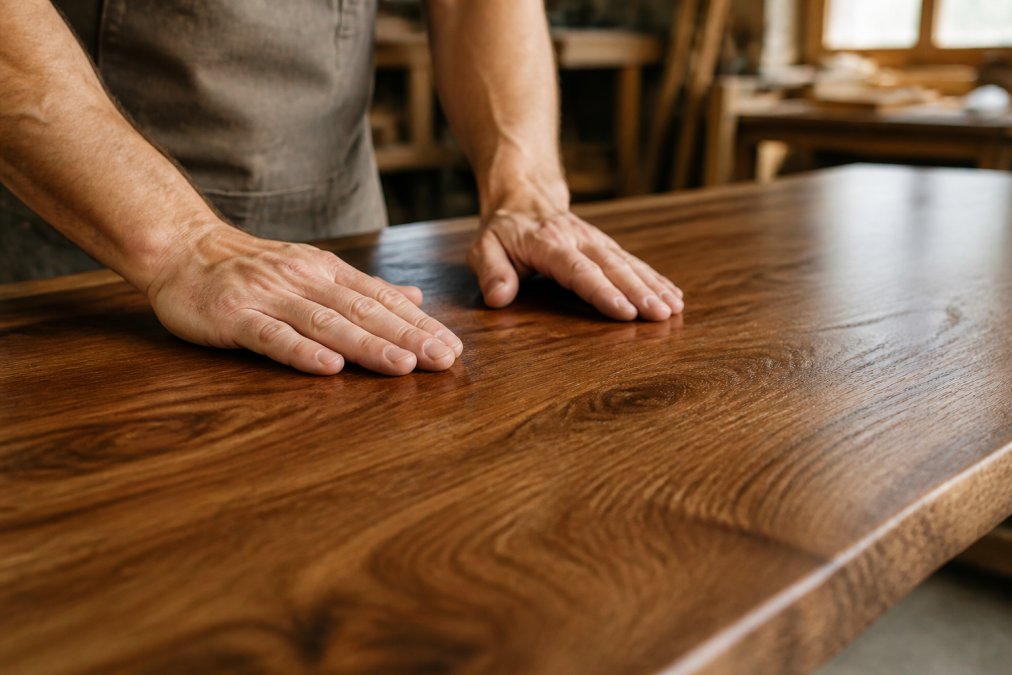
Solid timber is the benchmark. Kiln-dried hardwood such as oak, maple, walnut, or ash has been dried in a controlled environment to prevent warping and cracking. It holds screws and joinery more reliably than any engineered alternative and can be refinished, repaired, and handed down. The grain pattern on solid wood runs continuously and naturally, which is one of the easiest ways to verify what you're looking at.
How to Spot Veneer, MDF, and Particleboard
Veneer is a thin slice of real wood bonded over a plywood core or MDF substrate. Quality plywood with a veneer face is a legitimate construction method used in fine furniture for centuries. The problem is veneer applied over particleboard, a compressed mixture of wood chips and adhesive resin with low structural integrity that swells when exposed to moisture and cannot hold fasteners well.
To identify what you're working with: look at edges and undersides. Solid wood shows continuous grain through the thickness. Veneer shows a thin decorative layer with a different substrate visible at the edge. Particleboard has a rough, speckled cross-section. MDF is smooth and gray-brown throughout.
According to the Hardwood Federation's guidance on wood products, understanding the difference between solid wood and engineered wood products is essential for long-term purchasing decisions.
The Weight Test and Grain Pattern Check
Pick up a drawer or lift the corner of a chair. Solid wood and quality plywood are noticeably heavier than particleboard for the same volume. A piece that feels light and top-heavy is often built with a dense decorative face and a hollow or low-density core.
The grain pattern check is equally reliable. On solid wood, the grain flows naturally and slightly irregularly, continuing around edges and through thickness. On veneer, the pattern is perfectly symmetrical and stops abruptly at the edge. On printed MDF or particleboard, the pattern repeats at regular intervals, a telltale sign of photographic film rather than real wood.
Types of Furniture Joinery and Why They Define Durability
Frame construction is where furniture longevity is truly decided. Two pieces can look identical while one uses precision joinery and the other relies entirely on staples and adhesive.
Dovetail, Mortise and Tenon, and Corner Blocks
Dovetail joints are the gold standard for drawer construction. The interlocking trapezoidal shape creates mechanical resistance in multiple directions, holding the joint under tension without relying on glue alone. Hand-cut dovetails have slight irregularities, while machine-cut dovetails are perfectly uniform. Both are legitimate; what you're ruling out is a drawer held with staples or a simple butt joint.
Mortise and tenon joinery defines chair and table frame construction. A tenon (projecting piece) fits precisely into a mortise (receiving cavity) and is glued and sometimes pinned. This joint resists racking, the lateral stress that causes chairs to wobble and eventually fail. A well-executed mortise and tenon joint in kiln-dried hardwood will outlast the person who buys the piece.
Corner blocks are triangular reinforcements glued and screwed into interior corners of chair and sofa frames. Invisible from outside but critical, they signal a manufacturer who builds for structural integrity. Lift a seat cushion and look into the frame cavity if possible: the presence of corner blocks, especially ones both glued and screwed, is a strong quality indicator.
| Joint Type | Best Used For | What to Look For |
|---|---|---|
| Dovetail | Drawer boxes | Interlocking teeth, slight hand-cut variation |
| Mortise and tenon | Chair and table frames | Tight fit, no wobble under lateral pressure |
| Corner blocks | Sofa and chair frame corners | Glued and screwed, not just tacked |
| Dowel joints | Cabinet carcasses | Straight alignment, no flex |
How to Check Sofa Frame Quality Before You Buy
A sofa absorbs weight, lateral movement, and years of repeated impact, making frame quality non-negotiable.
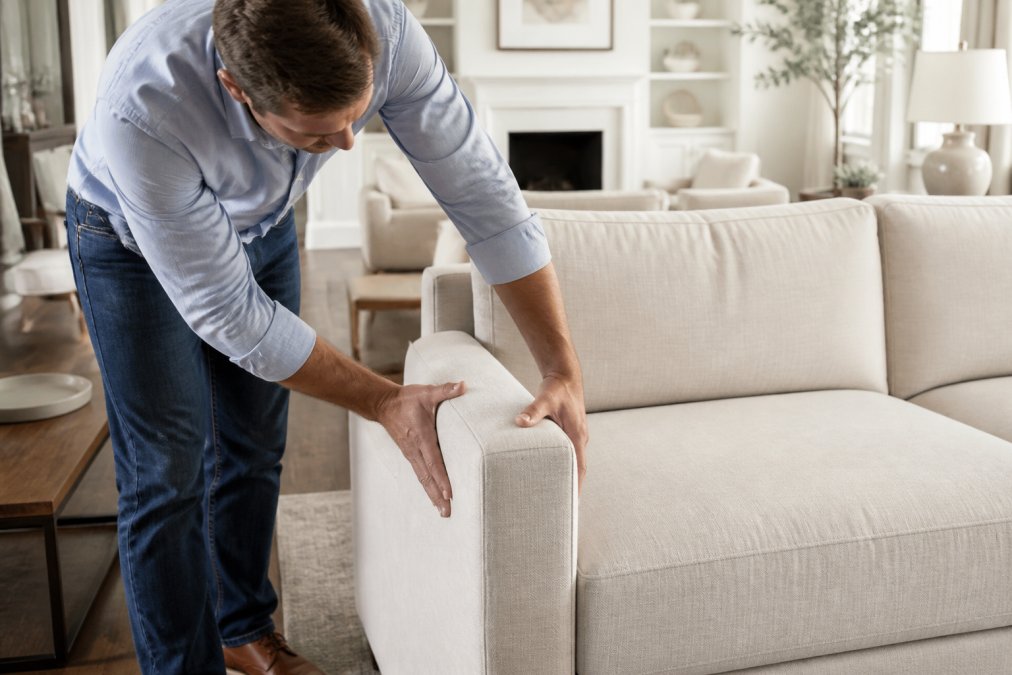
The wobble test is your first move. Grab the arm and push it laterally. A quality frame built with kiln-dried hardwood and proper joinery feels completely solid. Any flex, creak, or give signals inadequate construction. Lift one front leg a few inches off the ground: the opposite rear leg should lift simultaneously, indicating a rigid, unified frame.
Spring Support Systems: Eight-Way Hand-Tied vs Synthetic Webbing
Eight-way hand-tied springs are the traditional benchmark: each coil spring is tied in eight directions to neighboring springs and the frame, creating a unified, responsive support system that distributes weight evenly and resists sagging. This labor-intensive construction is reserved for quality pieces.
Sinuous springs (S-springs or no-sag springs) are a legitimate mid-tier alternative. Well-tensioned sinuous springs with proper spacing perform reliably, though they lack the longevity of eight-way hand-tied construction.
Synthetic webbing alone, without any spring system, is the lowest tier. It works initially but loses tension over time, leading to the "hammock" sag that makes older sofas feel broken. As noted in the American Home Furnishings Alliance's consumer resources, the type of support system directly affects both comfort and product lifespan.
Cushion Density and Fill Materials
Cushion density is measured in pounds per cubic foot and matters more than softness. High-density foam cushions feel firmer initially but hold their shape far longer. Low-density foam compresses quickly and doesn't recover, which is why budget sofas feel sunken within a year or two.
Quality cushions typically use a high-density foam core wrapped in down or down-alternative fiber for a softer hand feel. Press into the seat cushion firmly and release. A quality fill recovers quickly and completely. A poor fill stays compressed or recovers unevenly.
Hardware, Upholstery, and the Details That Signal Craftsmanship
Hardware on furniture is where manufacturers either commit to quality or quietly cut corners. Most buyers never check these details, exactly why they matter.
Upholstery Grade, Rub Count, and Seam Alignment
Upholstery grade refers to fabric classification by intended use. Residential-grade fabric is rated for normal household traffic. Contract-grade fabric, used in commercial settings, is built to a higher standard. The key metric is rub count (Martindale or Wyzenbeek rating), which measures how many abrasion cycles a fabric withstands before showing wear.
For upholstered furniture with daily use, look for fabric with a rub count above 15,000 Wyzenbeek double rubs. Performance fabrics with stain resistance and tensile strength ratings above that threshold are worth the premium for households with children or pets.
Seam alignment is a fast visual quality check. On well-upholstered pieces, patterns match across seams, fabric is pulled evenly without puckering, and welting or piping runs in a straight, consistent line. Misaligned seams or bunching fabric indicates rushed upholstery work, regardless of fabric cost.
Hinges, Drawer Slides, and Handles
Open and close every drawer and door. Full-extension slides allow complete opening, giving access to full depth. Soft-close hinges and slides use hydraulic mechanisms to prevent slamming and reduce wear. These signal a manufacturer thinking about long-term performance.
Check handles by gripping and applying lateral pressure. Quality hardware is mounted with machine screws into solid backing material, not just into the face panel. Handles that flex or feel hollow are mounted into MDF or thin plywood without proper reinforcement.
Sustainability, Off-Gassing, and Repairability: The Modern Quality Checklist
Beyond construction and materials, three additional dimensions deserve evaluation.
Off-gassing refers to the release of volatile organic compounds from adhesives, finishes, foams, and engineered wood products. Particleboard and MDF bonded with urea-formaldehyde adhesives can off-gas for months after purchase. The EPA's guidance on indoor air quality and VOC emissions identifies furniture as a significant source of indoor VOC exposure. Look for pieces specifying low-VOC or zero-VOC finishes and ask about adhesives used in engineered wood components.
Eco-certification is the most reliable shortcut for sustainability claims. The Forest Stewardship Council certifies wood sourced from responsibly managed forests. GREENGUARD certification verifies that a product meets chemical emission standards for indoor air quality. These require third-party verification, distinguishing them from unverifiable marketing language.
Repairability determines whether a piece can be a generational investment or disposable. A solid timber dining table with mortise and tenon construction can be disassembled, refinished, and reupholstered. A particleboard table with cam locks cannot be meaningfully repaired once surfaces delaminate or joints fail. Ask whether a local craftsman could restore it in 20 years. If the answer is no, the piece isn't truly built to last.
Second-hand and vintage inspection follows the same framework but adds one extra step: check for past repairs. Older furniture built to traditional standards often shows evidence of repairs that have held for decades, actually a positive signal. What you're looking for is whether the original construction remains sound beneath any refinishing or reupholstery.
Your In-Store and Online Inspection Checklist for High Quality Furniture
Use this checklist every time you evaluate a piece, whether in a showroom or online.
Frame and Materials
- Is the frame constructed from kiln-dried hardwood or quality plywood?
- Does the grain pattern flow naturally and continuously, or does it repeat mechanically?
- Does the piece feel appropriately heavy for its size?
- Are edges and undersides showing solid wood cross-section, or a layered substrate?
Joinery and Structural Integrity
- Do drawers use dovetail joints rather than staples or butt joints?
- Is there evidence of mortise and tenon or corner block construction?
- Does the wobble test reveal a rigid, unified frame with no lateral flex?
- Do all joints appear glued and screwed rather than relying on adhesive alone?
Upholstery and Cushions
- Does the fabric have a rub count above 15,000 Wyzenbeek double rubs?
- Are seams aligned, with patterns matching across panels?
- Does the cushion recover fully and quickly after compression?
- Is the cushion fill a high-density foam core with a quality wrap?
Hardware and Mechanisms
- Do drawers use full-extension slides with soft-close mechanisms?
- Do hinges operate smoothly with no resistance or play?
- Does hardware feel solid under lateral pressure, with no flex?
Sustainability and Safety
- Does the piece specify low-VOC or zero-VOC finishes?
- Is there FSC or GREENGUARD certification documentation available?
- Can the piece be repaired, refinished, or reupholstered by a craftsman?
For Online Purchases
- Are construction details specified in the product description (joint type, wood species, foam density)?
- Are customer photos available showing the piece in real living spaces?
- Is the return policy clearly stated for pieces that don't work in your space?
Reputable manufacturers make construction details available because they're confident in what's inside.
The challenge with buying furniture that genuinely lasts is that the most important quality indicators are hidden from view. Solid timber frames, eight-way hand-tied springs, dovetail joinery, and high-density cushion fill don't photograph well, which is why so many buyers end up with beautiful-looking pieces that disappoint within a few years. Tom Collins Home is built around the opposite approach: handcrafted construction, materials selected for longevity, and design rooted in the classics that have already proven they last. Explore the collection and find pieces built to the standard this guide describes.
Frequently Asked Questions
What are the primary indicators of high quality furniture?
The clearest indicators are frame construction and joinery. Look for kiln-dried hardwood frames, dovetail or mortise and tenon joints, and corner blocks that are glued and screwed. On upholstered pieces, check cushion density and fabric rub count. Weight is also a reliable signal: solid timber and quality construction add meaningful heft. Flimsy, lightweight pieces almost always rely on particleboard or MDF with stapled joints that loosen over time.
What is the difference between solid wood and veneer in quality furniture?
Solid wood is milled from a single timber and can be refinished multiple times, making it genuinely long-lasting. Veneer is a thin slice of real wood bonded over a plywood core or MDF substrate. Quality veneer over a plywood core is structurally sound and more dimensionally stable than solid wood in humid environments. The concern is veneer over particleboard, which swells, chips, and cannot be repaired. Check edges and undersides to identify what's underneath the surface.
How can you tell if a sofa is built to last?
Start with the frame: a quality sofa frame uses kiln-dried hardwood and is glued, screwed, and reinforced with corner blocks. Lift one front leg slightly off the floor; if the opposite rear leg also lifts, the frame has structural integrity. Eight-way hand-tied springs indicate a premium support system. Cushion density matters too: high-quality foam holds its shape under sustained use. Finally, check seam alignment and upholstery grade fabric with a rub count above 15,000 for everyday use.
Why is joinery important when evaluating furniture quality?
Joinery determines how long a piece holds together under real use. Dovetail joints and mortise and tenon connections interlock mechanically, so the bond strengthens under load rather than weakening. Stapled or dowel-only joints rely entirely on adhesive, which fails with humidity changes and repeated stress. When you examine types of furniture joinery, prioritize pieces where joints are visible, tight, and reinforced, rather than hidden behind filler or covered with decorative trim that may conceal poor construction.
This article was written using GrandRanker


