



Signs of High Quality Sofa Construction
Table of Contents
- What Makes High Quality Sofa Construction Matter
- Best Sofa Frame Materials and Their Durability
- How to Test Sofa Suspension for Long-Term Support
- Sofa Cushion Fill Types Comparison and Density
- Upholstery Fabric Quality: Durability and Weave
- Performing an In-Store Stability Test for Signs of High Quality Sofa Construction
- Budget-Tier vs. Investment-Tier Breakdown
- Sustainability and Eco-Friendly Construction Methods
- Frequently Asked Questions
Last Updated: September 1, 2026
What Makes High Quality Sofa Construction Matter
The difference between a sofa that lasts five years and one that lasts fifteen often comes down to details most shoppers never examine. A well-built sofa improves with age, while a poorly constructed one will sag, squeak, and fail within years.
At Tom Collins Home, we design and handcraft sofas that stand the test of time. What separates a well-built sofa from a disposable one is hidden in the frame materials, joinery techniques, suspension system, and upholstery craftsmanship.
Best Sofa Frame Materials and Their Durability
The frame is the skeleton of your sofa. A weak frame will eventually fail no matter how premium the cushioning is.
Kiln-Dried Hardwood vs. Engineered Alternatives
Kiln-dried hardwood is the gold standard for sofa frames. This wood has been dried in a controlled kiln environment, removing moisture and reducing the risk of warping, twisting, and cracking over time. The kiln-drying process ensures joints stay tight because the wood is dried to a consistent moisture level before construction.
Engineered hardwood and particle board are cheaper alternatives but don't perform the same way. Engineered hardwood is made from wood veneers glued to a plywood core and is prone to delamination. Particle board will start sagging within a few years because it can't support sustained weight. If you're comparing two sofas at the same price point, the one with a kiln-dried hardwood frame will outlast the other by years.
Joinery Techniques That Prevent Wobbles
The way frame pieces are joined determines whether your sofa will feel solid or rickety after a few years of use.
Mortise and tenon joinery is the strongest traditional method. A mortise is a rectangular hole cut into one piece of wood, and a tenon is a protruding piece cut on another. The tenon slides into the mortise and is glued and often doweled for reinforcement, creating an incredibly strong joint.
Dowel joints are common and effective, joining two pieces of wood with wooden dowels glued into holes drilled in both pieces. Corner blocks are wooden blocks glued and screwed to the inside corners of the frame where pieces meet, reinforcing joints and preventing the frame from racking.
To test frame stability in a showroom, push down on the corners and sides of the sofa. A solid frame won't flex or creak.
How to Test Sofa Suspension for Long-Term Support
The suspension system determines how the sofa will feel and how long it will maintain that feel. A weak suspension will bottom out and sag within a few years.
Eight-Way Hand-Tied Springs vs. Sinuous Springs
Eight-way hand-tied springs are the most durable suspension system (astm.org). Each spring is individually tied to eight surrounding springs using twine, creating a web of interconnected support that distributes weight evenly and lasts for decades.
Sinuous springs (also called serpentine or no-sag springs) are a practical middle ground. These continuous metal wires bent into a wave shape are attached to the front and back of the frame. They're less expensive than hand-tied springs and still provide good support when properly installed, easily lasting 10-15 years with normal use.
Some sofas use sinuous springs in certain areas and hand-tied springs in others, balancing cost and performance. High-quality webbing can provide adequate support, but it doesn't have the longevity of spring systems.
The Squeak Diagnostic and What It Reveals
Squeaking in a sofa is almost always a sign that something inside the frame or suspension is moving when it shouldn't be. If you hear squeaks when you sit down or shift your weight, it usually means the springs are rubbing against the frame or the suspension system is inadequately attached.
In a showroom, sit on the sofa and shift your weight around. If you hear creaking or squeaking, ask the salesperson what's causing it. Squeaks that appear within the first few months of ownership often signal poor construction or inadequate assembly.
:::pro-tip If you buy a sofa and it develops squeaks, sit on it in different spots to isolate where the sound is coming from. Squeaks from the back usually indicate a frame or joint issue. Squeaks from the seat usually indicate a spring or webbing problem. :::
Sofa Cushion Fill Types Comparison and Density
Cushions determine how a sofa feels and how long it will stay comfortable. The wrong cushion fill will flatten quickly; the right fill will maintain its shape for years.
High-Resiliency Foam and Down-Blend Options
High-resiliency (HR) foam is the most durable cushion fill. It's a dense, engineered foam that resists compression and maintains its shape better than standard polyurethane foam. A sofa with HR foam cushions will feel supportive for 10-15 years or more (peer-reviewed research). Standard polyurethane foam will start to flatten within 3-5 years.
Cushion density is measured in pounds per cubic foot. A density of 2.0 or higher is considered high-quality for HR foam. Anything below 1.5 is budget-tier and will compress faster.
Down-blend cushions combine down (the soft inner feathers of waterfowl) with a foam core. Down provides comfort and a luxurious feel, while the foam core provides structure and support. A common compromise is a high-resiliency foam core with a thin layer of down or down-alternative on top, giving you the durability of HR foam with some of the comfort of down. Avoid sofas with cushions made entirely of low-density polyurethane foam or memory foam.
Upholstery Fabric Quality: Durability and Weave
The fabric is what you touch and what you see. Quality upholstery will resist pilling, fading, and wear, while cheap fabric will look shabby within a year.
Double-Rub Count and Tight Weave Standards
Double-rub count measures fabric durability. A double rub is one back-and-forth motion of a standardized testing device against the fabric. Higher double-rub counts resist wear and pilling better.
Industry standards:
- 15,000+ double rubs: heavy-duty, suitable for high-traffic living rooms and households with kids or pets
- 10,000-15,000 double rubs: good durability, suitable for normal household use
- 5,000-10,000 double rubs: moderate durability, better for low-traffic areas
- Below 5,000 double rubs: light-use only, not recommended for primary living spaces
For busy households, look for fabrics rated 15,000 double rubs or higher to avoid visible wear within a few years.
Tight weave fabrics resist pilling and snagging better than loose weaves. When evaluating fabric in a showroom, run your hand across it. If it feels smooth and uniform, it's likely a tight weave.
Stitching, Seam Integrity, and Welt Cord Details
Seam puckering is a sign of poor craftsmanship. Seams should be straight and even. Welt cord (also called piping) is the decorative cord that runs along cushion edges and seams. Quality welt cord is tightly wrapped and securely stitched. Stitch density matters, more stitches per inch means stronger seams. Pattern alignment on patterned fabrics indicates attention to detail and suggests overall construction quality.
Performing an In-Store Stability Test for Signs of High Quality Sofa Construction
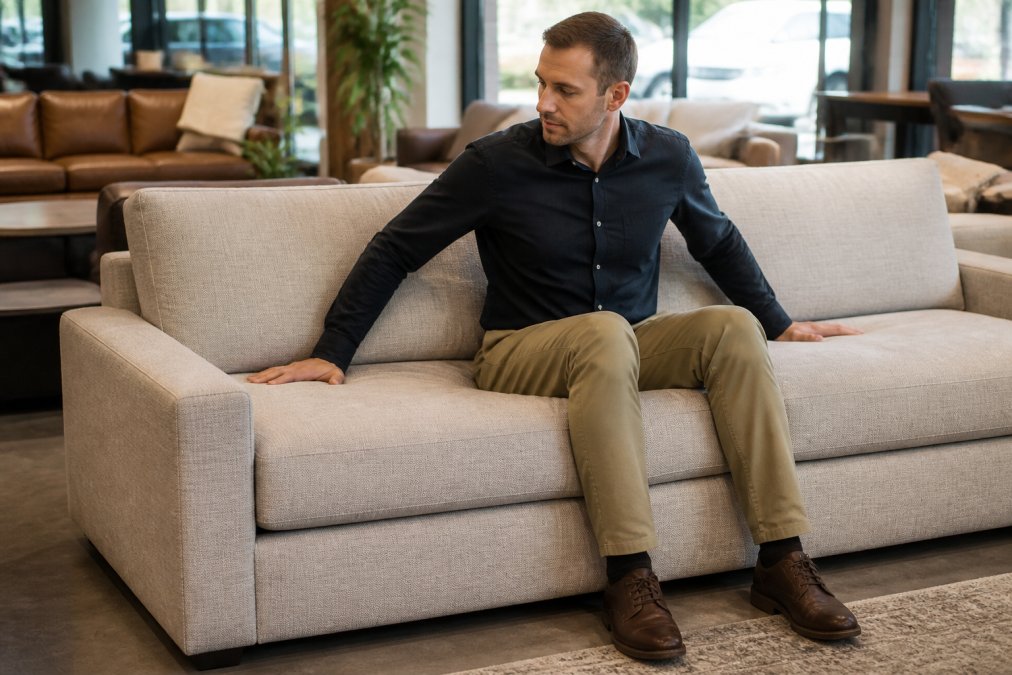
You don't need to be a furniture expert to evaluate a sofa in person. A few simple tests will reveal a lot about how well it's built.

Step-by-Step Testing Checklist
1. Press on the frame (not the cushions). Push down firmly on different parts of the frame, the arms, the sides, the back. The frame should feel solid with minimal flex.
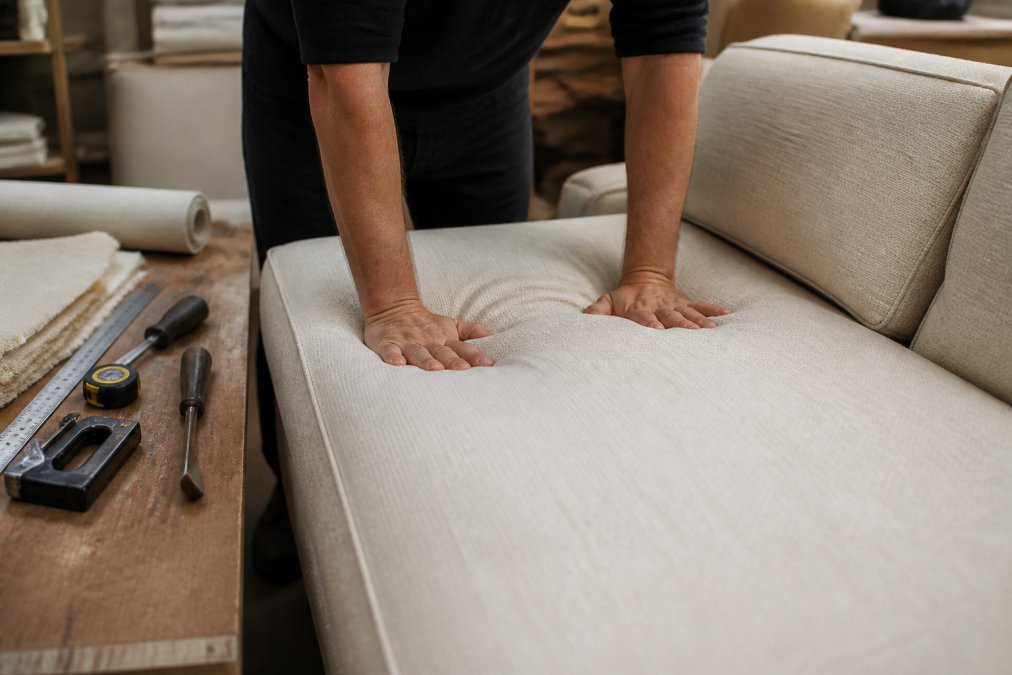
2. Test the cushions for compression and recovery. Press down on a cushion and hold for a few seconds, then release. The cushion should bounce back to its original shape quickly.
3. Sit down and shift your weight. Sit on the sofa and move around. Bounce gently. Listen for squeaks or creaks. Feel for any wobbling or instability.
4. Check the undercarriage. If possible, look underneath the sofa. You should see a wooden frame, corner blocks, and either springs or webbing. Avoid sofas where you can see particle board or excessive stapling with no glue.
5. Examine the seams and stitching. Look at the seams along the back, sides, and cushion edges. Stitching should be straight and even. Welt cord should be tightly wrapped and secure.
6. Feel the fabric. Run your hand across the upholstery in different directions. It should feel uniform and smooth.
7. Check for frame warping. Stand back and look at the sofa's silhouette. The back should be straight, the arms should be even, and the seat should be level.
| Test | What to Look For | Red Flag |
|---|---|---|
| Frame press | Minimal flex, no creaking | Visible movement, loud creaks |
| Cushion recovery | Quick return to shape | Slow or incomplete recovery |
| Weight shift | Stable, quiet | Wobbling, squeaking |
| Undercarriage | Wood frame, corner blocks, springs | Particle board, excessive staples |
| Seams | Straight, even, no puckering | Puckered, uneven, loose stitches |
| Fabric feel | Smooth, uniform texture | Thin areas, loose threads |
| Frame alignment | Straight back, even arms, level seat | Twisted, uneven, warped |
Budget-Tier vs. Investment-Tier Breakdown
Understanding the difference between budget and investment-tier sofas helps you make a decision that aligns with your expectations and timeline.
Budget-tier sofas ($800-$1,200) use particle board or low-grade engineered wood frames, sinuous or webbing suspension systems, low-density foam cushions (under 1.5 pounds per cubic foot), and basic upholstery fabrics with lower double-rub ratings (5,000-10,000). These sofas will be comfortable for 2-4 years but will start showing wear quickly.
Mid-tier sofas ($1,500-$2,500) use kiln-dried hardwood frames with dowel joinery, eight-way hand-tied or quality sinuous springs, high-resiliency foam cushions (1.8-2.2 density), and upholstery fabrics rated 12,000-15,000 double rubs. These sofas will last 8-12 years with normal use.
Investment-tier sofas ($2,500 and up) use premium kiln-dried hardwood frames with mortise and tenon joinery, eight-way hand-tied springs with corner blocks, high-resiliency foam (2.2+ density) or down-blend cushions, and premium upholstery fabrics (15,000+ double rubs). These sofas are built to last 15-20+ years and can be reupholstered or have cushions replaced, extending their life further.
The Tom Collins Home collection exemplifies investment-tier construction. Our sofas, like the Bahama Mama Sofa and Clover Club Sofa in Boucle, are handcrafted with kiln-dried hardwood frames, quality suspension systems, and premium upholstery. These pieces are designed to be heirloom sofas you'll have for decades.

Sustainability and Eco-Friendly Construction Methods
As awareness of environmental impact grows, more furniture makers are adopting sustainable practices.
Kiln-dried hardwood from sustainably managed forests is more eco-friendly than particle board. Natural upholstery fabrics like linen, cotton, and wool are biodegradable and don't shed microplastics like synthetic fabrics. Water-based stains and finishes are replacing solvent-based products, reducing volatile organic compounds (VOCs) that off-gas into your home. Local manufacturing reduces transportation emissions.
When evaluating sustainability, ask about the sofa's frame material sourcing, upholstery fabric composition, cushion fill type, and finishing products. A truly sustainable sofa uses natural or recycled materials, non-toxic finishes, and comes from a manufacturer committed to responsible sourcing.
Choosing a sofa is one of the biggest furniture decisions you'll make. The difference between a sofa that disappoints you in three years and one that becomes more comfortable with age comes down to the details of its construction. By understanding frame materials, suspension systems, cushion density, upholstery durability, and stitching quality, you can evaluate a sofa with confidence.
When you're ready to invest in a sofa built to last, Tom Collins Home offers handcrafted pieces designed with the same attention to construction quality covered in this guide. Each sofa is built with kiln-dried hardwood frames, quality suspension systems, and premium upholstery. Get updated on new collections and exclusive releases by connecting with our team, and discover why our customers choose pieces they'll own for decades.
Frequently Asked Questions
Q: How can you tell if a sofa is high quality?
A: High quality sofa construction shows itself through kiln-dried hardwood frames, eight-way hand-tied springs or premium sinuous springs, high-resiliency foam cushions, and tight weave upholstery with a double-rub count above 15,000. Check for mortise and tenon joinery, corner blocks reinforcing joints, and no squeaks when you sit. Run your hand along seams, they should be straight with even stitching. Quality sofas feel solid when you press the cushions; they return to shape immediately rather than staying compressed.
Q: What is the 2/3 rule for couches?
A: The 2/3 rule refers to proper cushion density and support distribution. A quality sofa should maintain approximately two-thirds of its original cushion height after five years of normal use. This depends on cushion fill type, high-resiliency foam with down-blend wrapping typically meets this standard better than low-density foam. Sofas with sinuous springs or eight-way hand-tied springs preserve cushion integrity longer because the suspension system absorbs sitting pressure rather than transferring it directly to the fill material.
Q: Does frame material affect sofa longevity?
A: Frame material is one of the most critical factors in sofa longevity. Kiln-dried hardwood frames resist warping and cracking far better than particle board or plywood, often lasting 15+ years with proper care. Kiln-dried wood is dried in controlled conditions to remove moisture, preventing the frame from shifting over time. Engineered hardwood offers a middle ground. Particle board frames, common in budget sofas, deteriorate within 3-5 years. Joinery method matters equally, mortise and tenon joints with corner block reinforcement create structural integrity that staple-only construction cannot match.
Q: What should I look for when testing sofa suspension in person?
A: Press down firmly on different areas of the seat and back cushions, quality suspension returns to shape within 2-3 seconds. Sit on the sofa and gently rock side-to-side to check for wobbles or creaking; the frame should feel rock-solid. Listen for squeaks, which signal loose joints or poor webbing. Lift the sofa slightly if possible to feel its weight; heavier construction usually means more substantial materials and better support systems. Check underneath for visible webbing and springs, eight-way hand-tied springs or sinuous springs are superior to basic coil systems.


