



7 Steps to Measure Dining Table Height Correctly
Last Updated: November 8, 2026
Quick Summary
To measure dining table height, hook a tape measure on the floor at the table's edge and pull it straight up to the top surface, not the edge trim. Standard dining table height is 30 inches from floor to tabletop, with most tables falling between 28 and 30 inches. Repeat at three points and average the readings if they differ.
- Measure to the highest point of the tabletop, never to the apron below it.
- The seat-to-table gap should land between 10 and 12 inches for comfort.
- Underside clearance should be at least 24 to 25 inches for a standard chair.
- Table height equals chair seat height plus 10 to 12 inches.
- Leave 36 inches between the table edge and the nearest wall or furniture.
Table of Contents
- Why Dining Table Height Matters Before You Measure
- How to Measure Dining Table Height in Inches
- Where to Measure and Why Not to Measure to the Apron
- How to Measure Dining Table Height Calculator
- Standard Height of Dining Table in cm and Inches
- How to Measure Dining Table Height for 4 Seats
- The Chair-Fit Test and Fixes for Mismatched Furniture
- Find a Dining Table Built to the Right Height
- Frequently Asked Questions
Why Dining Table Height Matters Before You Measure
A dining table that sits at the wrong height ruins every meal, no matter how beautiful the wood or how elegant the finish. Before you measure, it helps to know what a correct dining table height actually is. The standard is 30 inches from the floor to the top of the table, and most dining tables fall between 28 and 30 inches.
That range exists for one reason: your chair. A standard dining chair has a seat height of about 18 inches. The gap between the seat and the tabletop should land between 10 and 12 inches. That gap is what lets you sit upright, rest your forearms, and eat without hunching.
A 30-inch height works with the widest range of chairs. Get the height wrong, and you feel it in your shoulders within ten minutes.
The Numbers That Define a Comfortable Table
Here are the measurements that matter, all in one place:
| Measurement | Standard Range | What It Controls |
|---|---|---|
| Floor to tabletop | 28-30 in (71-76 cm) | Arm and shoulder comfort |
| Chair seat height | 18-23 in | Leg comfort |
| Seat-to-table gap | 10-12 in | Knee and thigh room |
| Apron underside clearance | At least 24-25 in | Legroom under the top |
Keep these four numbers in mind. Every measurement you take below is really a check against this list.
How to Measure Dining Table Height in Inches
Measuring dining table height takes one tool and about two minutes. Here is the exact procedure we recommend.
What you need: a tape measure, a pencil, and a helper if the table is large.
- Clear the tabletop completely. Remove runners, centerpieces, and anything else sitting on the surface.
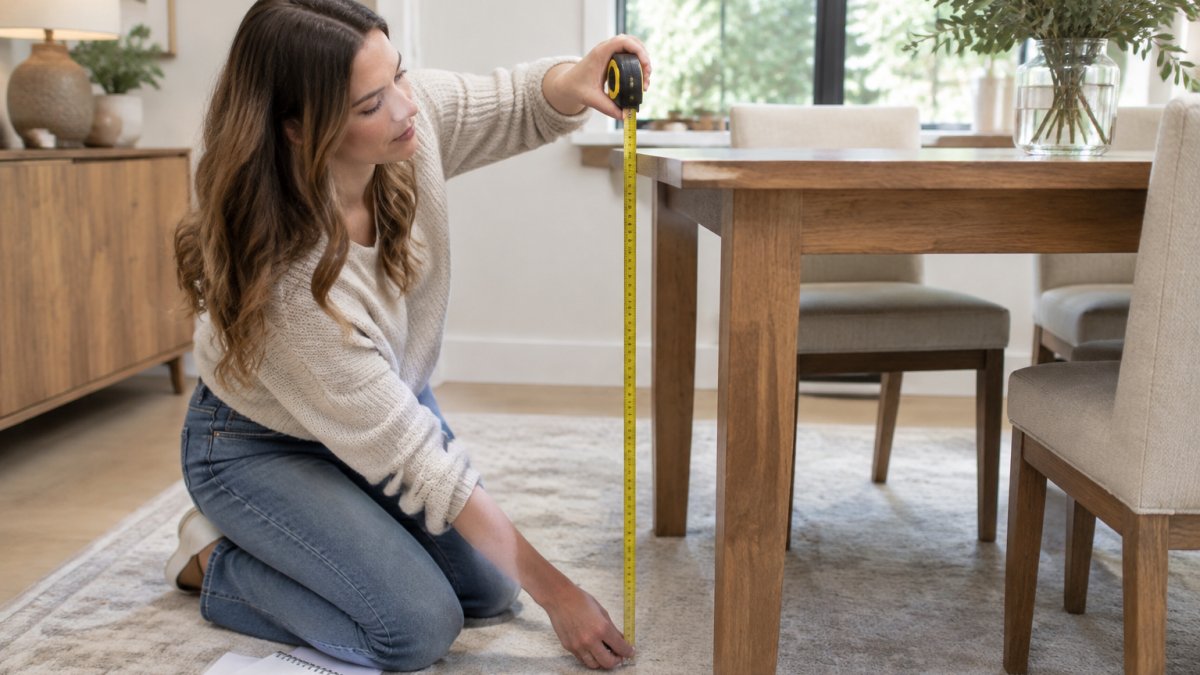
- Hook the tape measure on the floor at the table's edge, not under the middle.
- Pull the tape straight up, keeping it vertical. A tilted tape adds length.
- Read the number where the tape meets the top surface, not the edge trim.
- Repeat at three points around the table and write each number down.
- Use the average if the readings differ, and note any gap over 1/4 inch.
Measuring Around a Thick Top, Lip, or Uneven Floor
Thick tops and uneven floors are where most measurements go wrong. If your table has a thick top or a raised lip, measure to the highest point of the surface, since that is where plates and elbows actually rest.
Uneven floors need extra care. Take a reading at all four corners. If the numbers differ, measure from the highest floor point, because that is where the table effectively sits. A table that reads 30 inches on one side and 29 1/2 on the other is really a 30-inch table on a sloped floor.
Where to Measure and Why Not to Measure to the Apron
Always measure to the top of the tabletop, never to the apron. The apron is the wooden rail running under the top, and it sits lower than the surface. Measuring to the apron gives you a number that is too short and tells you nothing about comfort.
The tabletop is the working surface. It is where your plate sits and where your forearms rest. That is the number that has to match your chair.
Apron and Underside Clearance as Separate Measurements
Underside clearance is a second measurement, and most guides skip it. Hook your tape on the floor and measure to the lowest point of the apron or underside. This number controls legroom, and it should be at least 24 to 25 inches for a standard chair.
Why does it matter? A table can hit 30 inches at the top and still pinch your knees if the apron hangs low. Measure both numbers. If the underside clearance is under 24 inches, look for a table with a thinner apron or a pedestal base.
How to Measure Dining Table Height Calculator
No calculator app needed, but the formula only works if you feed it accurate inputs. Most people measure the chair once, round the number, and end up with a table that feels wrong.
The formula: Table height = chair seat height + 10 to 12 inches.
Input 1, Chair seat height. Measure from the floor to the top of the seat cushion at the front edge of the chair, where your thighs actually rest.
Input 2, The gap you actually want. The 10-to-12-inch range is not arbitrary.
Worked examples with real chair types:
- Standard upholstered dining chair, 18-inch seat, firm cushion: 18 + 11 = 29-inch table.
- Wooden Windsor chair, 17 1/2-inch seat, no cushion: 17.5 + 11 = 28 1/2-inch table.
- Counter stool, 24-inch seat: 24 + 11 = 35-inch counter-height table.
- Bar stool, 30-inch seat: 30 + 11 = 41-inch bar-height table.
If you already own the chairs, this formula settles the question fast. If you are buying both, start with the table and match the chair to it, because tables are harder to modify than chairs.
Standard Height of Dining Table in cm and Inches
The standard height of a dining table is 30 inches, or about 76 centimeters. Most dining tables sold in the U.S. land between 28 and 30 inches, which converts to roughly 71 to 76 centimeters.
Here is how the three common heights compare:
| Table Type | Height (in) | Height (cm) | Paired Stool or Chair |
|---|---|---|---|
| Standard dining | 28-30 | 71-76 | 18-inch chair |
| Counter height | 34-36 | 86-91 | 24-inch stool |
| Bar height | 40-42 | 102-107 | 30-inch stool |
Height (cm)
Counter-height tables sit about 6 inches taller than standard, and bar-height tables add another 6. The chair-fit rule stays the same at every height: keep that 10-to-12-inch gap.
How to Measure Dining Table Height for 4 Seats
Seat count does not change table height. A four-seat table and an eight-seat table both sit at 30 inches because the chair is the same.
Step 1, Measure height as usual. Floor to tabletop at three points, average the readings, and note any gap over 1/4 inch. A four-seat table is small enough that a single warped leg can tilt the whole top, so check all four corners on an uneven floor.
Step 2, Measure the seating edge. For four seats, allow 24 inches of table edge per person. A rectangular table for four should measure at least 48 inches long and 36 inches wide. A round table for four needs a diameter of about 42 to 48 inches. Measure the actual usable edge, not the outer dimension, if the table has thick legs or a trestle base that eats into knee space.
Step 3, Measure the room clearance. Leave 36 inches between the table edge and the nearest wall or furniture so a chair can pull out and someone can walk behind it.
Step 4, Run the seated fit test. Sit in one of the actual chairs at the table. Slide a fist between your thigh and the underside of the tabletop.
Watch out: a four-seat table placed against a wall loses one seating edge to clearance, so measure the free edge, not the full perimeter, when you check the 24-inch-per-person rule.
If the height and the clearance both check out, the table fits.
The Chair-Fit Test and Fixes for Mismatched Furniture
The fastest check is the fist test. Sit in your chair at the table and make a fist. Slide it between your thigh and the underside of the tabletop. If the fist fits with a little room, the pairing works. If your knuckles scrape, the table is too low or the chair is too tall.
A common mistake is buying a beautiful table and discovering the chairs sit too high. Watch out: a seat-to-table gap under 10 inches traps your thighs and forces you to sit sideways.
Fixes for a mismatch:
- Gap too small: swap to a lower-profile chair cushion, or move to a table with a thinner top.
- Gap too large: add a seat cushion, or choose a chair with a taller seat.
- Knees hitting the apron: look for a table with a pedestal base or a shallower apron.
If you are still choosing chairs, our guide to modern dining chairs walks through seat heights and pairing in more detail.
Find a Dining Table Built to the Right Height
The measurement work is already done for you once you know the 30-inch standard height. You only need to match your chairs and check your room.
The Chrome & Solid Ash Dining Table pairs a solid ash top with polished stainless steel cylinder legs and measures 90 by 38 by 30 inches, seating six to eight. The Solid Ash Oval Dining Table brings soft, sculptural lines at 84 by 38 by 30 inches. For a lighter look, the Light Solid Ash Dining Table offers a clean rectangular top at 90 by 40 by 30 inches. The Trident Dining Table adds a rounded silhouette in a warm walnut finish, offered in Light Walnut and Dark Walnut.


Each piece is handcrafted and designed in Southern California. Measure once, then choose the table that fits your room and your chairs.
The height is settled. Now the only question is which table earns the space. Tom Collins Home builds handcrafted dining tables in solid ash, each one designed in Southern California and finished to a true 30-inch height. Browse the collection and find the piece that fits your room, your chairs, and the way you actually eat.
Frequently Asked Questions
Is 32 inches too high for a dining table?
Yes, 32 inches sits above the standard dining table height range of 28 to 30 inches. A table that tall pushes the tabletop too far above a standard 18-inch chair seat, so most diners end up reaching up rather than resting their forearms. If you already own a 32-inch table, pair it with counter-height stools or chairs with a seat around 24 inches to restore a comfortable 10 to 12 inch seat-to-table gap.
Where do you measure the height of a dining table?
Measure from the floor to the top of the tabletop, at the highest point of the table surface. Do not measure to the apron or the underside of the top. Run the tape vertically at a leg or pedestal so the reading stays square, then repeat at two or three points around the table. If the readings differ, the floor is uneven or the top is not level, and the tallest reading is the true dining table height.
How much space should there be between a dining table and a chair seat?
Aim for 10 to 12 inches between the top of the chair seat and the top of the table. That gap lets most adults slide their legs under the table and rest their forearms without hunching. Chairs with a seat height of 18 to 23 inches pair with a standard 28 to 30 inch table. Less than 10 inches and knees hit the apron; more than 12 inches and diners sit too low to eat comfortably.
How do you check whether a dining table fits your chairs?
Pull a chair up to the table and sit down. Your feet should rest flat on the floor, your thighs should clear the apron with room to spare, and your forearms should rest on the tabletop without lifting your shoulders. Then check the seat-to-table gap with a tape measure: it should read 10 to 12 inches. If the chair tucks in but your knees touch the underside, the apron clearance is the problem, not the overall height.


