



How to Choose Durable Sofa Cushions That Last
Last Updated: November 4, 2026
Quick Summary
Choose durable sofa cushions by checking foam density in pounds per cubic foot before firmness, since density predicts whether cushions keep their shape. Look for high-density or high-resilience foam, tight-weave fabric, and loose cushions you can rotate, flip and fluff regularly.
- Density, firmness and resilience are separate specs; a firm low-density foam can still break down quickly.
- High-resilience foam springs back fast and holds loft longer, but check its PCF figure too.
- Rotate seat cushions front-to-back and left-to-right weekly to spread compression.
- A cushion that springs back within a second or two in the press-and-release test is still healthy.
- Many warranties cover frames and springs but exclude foam compression, which fails first.
Table of Contents
- Start With Foam Density, Not Firmness
- High-Density Foam vs Down Cushions: Which Fill Holds Up
- The Best Durable and Stain Resistant Fabric for Sofa Cushions
- How Cushion Construction and Layering Affect Support
- How to Prevent Sofa Cushion Sagging From Day One
- Matching Cushions to Body Weight, Posture, and Daily Use
- Warranty, Replacement Economics, and What to Inspect Before Buying
- Choosing Cushions at Tom Collins Home
- Frequently Asked Questions
Start With Foam Density, Not Firmness
Most shoppers test a sofa with a quick sit and call it done. That tells you how a cushion feels on day one, not how it will hold up after years of daily use.
Foam density is the weight of the foam per unit of volume, expressed in pounds per cubic foot (PCF).
Here is the distinction that trips up most buyers: a cushion can be soft and high-density, or firm and low-density. The two qualities are independent.
Density, Firmness, and Resilience Are Three Different Numbers
The biggest source of confusion in cushion shopping is treating density, firmness, and resilience as the same measurement. A spec sheet listing only one tells you only part of the story.
- Density (PCF) measures how much foam material is packed into a cubic foot. It is the best single predictor of how long a foam cushion resists compression and sagging. Higher density generally means longer service life at the same firmness.
- Firmness is how much the foam pushes back under a given load, usually described on a soft-to-firm scale or as an indentation force deflection (IFD) number. Firmness is a comfort preference, not a durability guarantee. A firm low-density foam can still break down quickly.
- Resilience is how quickly the foam springs back after compression, often expressed as a ball-rebound percentage. High-resilience (HR) foam returns quickly and tends to hold loft longer; low-resilience foam stays compressed and looks flat sooner.
A cushion can be high-density and soft, or low-density and firm. Read all three figures when available, and treat any single number as a starting point rather than a verdict.
Reading Pounds Per Cubic Foot on a Spec Sheet
A spec sheet lists density as a number followed by PCF or "lb/ft³." Look for that figure, not the marketing language around it.
A guest-room sofa can live happily at a lower foam density than a family-room seat that hosts movie nights every week.
Watch out: a spec sheet that lists only "high-density foam" without a PCF figure is a marketing claim, not a specification.
High-Resilience Foam and What It Actually Buys You
High-resilience (HR) foam is engineered to spring back quickly after compression. It tends to hold its loft longer than standard polyurethane foam and is a common choice for seat cushions that see heavy daily use.
HR foam is not a density grade by itself; it describes how the foam behaves. You can find HR foam at more than one density, so check the PCF figure alongside the resilience claim.
High-Density Foam vs Down Cushions: Which Fill Holds Up
Neither fill wins outright; the right answer depends on how you live. High-density foam holds its shape and needs little upkeep, while down delivers the sink-in softness many people want from a luxury sofa.
Down cushions feel plush and mold to your body, but pure down compresses flat and needs regular fluffing to keep its loft. Foam keeps its structure but can feel less inviting if it is the only fill.
Foam, Fiber, and Blended Fills Side by Side
| Fill Type | Feel | Upkeep | Best For |
|---|---|---|---|
| High-density foam | Supportive, firmer | Low, occasional rotation | Heavy daily use, family rooms |
| Down | Plush, sink-in | High, frequent fluffing | Low-traffic, formal living rooms |
| Polyester fiber | Soft, light | Medium, re-fluffs easily | Budget back cushions |
| Foam-and-down blend | Support with soft top | Medium | All-purpose seating |
| HR foam core with wrap | Resilient, tailored | Low | Long-lasting seat cushions |
A common mistake is buying pure down for a sofa the whole household uses every night. It looks wonderful in a showroom and goes flat fast under daily weight.
The Best Durable and Stain Resistant Fabric for Sofa Cushions
Fabric choice matters as much as fill when you want cushions that survive real life. Tight weaves resist spills and everyday abrasion better than loose, open weaves, and performance finishes add protection without changing the hand-feel much.
For households with kids or pets, look for a tight, high-twist weave and a removable cover you can clean. A linen sofa shows how a natural fiber can read relaxed while still holding up, and a hammered chenille sofa demonstrates a denser, family-friendly textile in practice.
Watch out: a beautiful loose weave that snags easily will look worn long before the foam underneath gives out. Match the fabric to your household, not just your Pinterest board.
How Cushion Construction and Layering Affect Support
Support comes from what sits under the cushion as much as from the cushion itself.
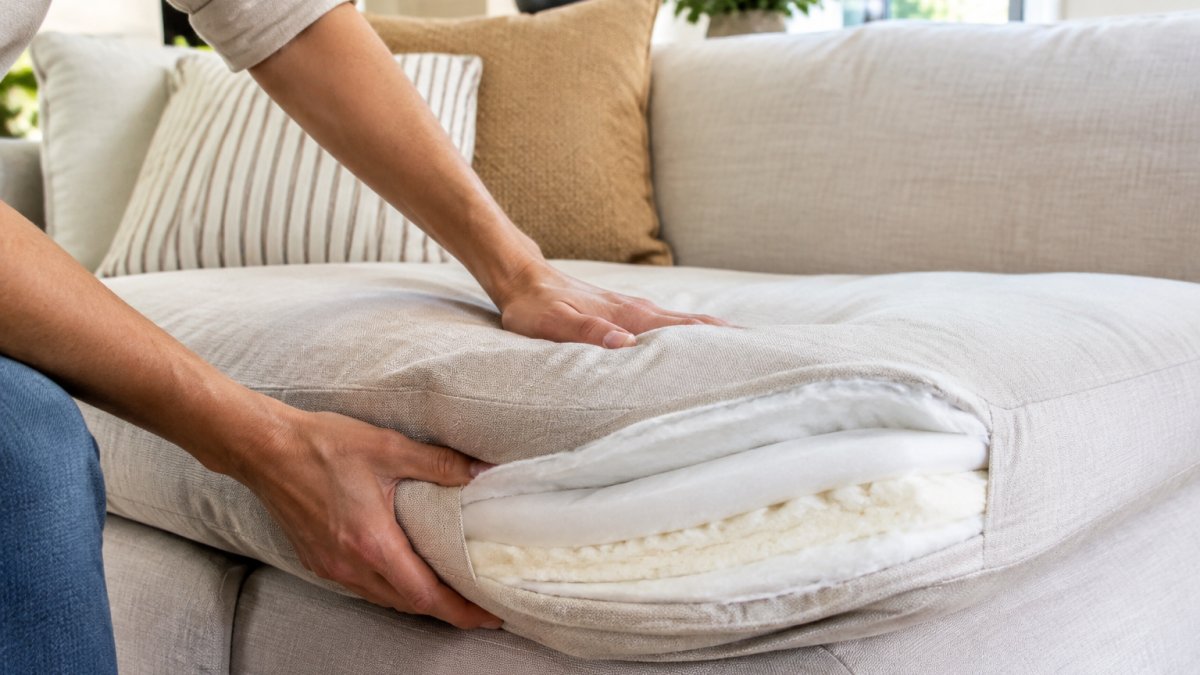
Loose cushions you can flip and rotate last longer than attached ones, because you can even out the wear. Attached cushions look tidy but compress in the same spot every time. If longevity is the goal, loose wins.
How to Prevent Sofa Cushion Sagging From Day One
Sagging rarely happens overnight; it builds from repeated pressure in the same spot. The fix starts the day the sofa arrives. Rotate and flip loose cushions weekly, and plump back cushions each time you tidy the room.
- Rotate seat cushions front-to-back and left-to-right weekly
- Flip reversible cushions to even out compression
- Fluff down and fiber back cushions daily
A common mistake is waiting until a cushion looks flat to act. By then the foam has lost resilience. Prevent sofa cushion sagging with small, regular habits rather than one big correction.
A Repeatable Way to Test Cushions for Wear
Most care advice stops at "rotate and fluff." The more useful skill is knowing how to check whether a cushion is actually losing support, so you can act before the foam is permanently compressed.
- The press-and-release test. Press your palm firmly into the center of the seat and release. A healthy foam cushion springs back within a second or two. If the dent lingers or the surface stays visibly compressed, resilience is dropping.
- The edge test. Sit on the front edge of the cushion, then move to the center. If the edge feels noticeably softer or bottoms out sooner than the middle, that zone is wearing faster and needs more rotation.
- The hand-under test. Slide your hand under the cushion and press up from below. You should feel firm, even resistance. A soft or hollow-feeling patch under the cover usually means the foam core has broken down in that area.
Watch out: a cushion that fails the press-and-release test in one spot but passes elsewhere is not necessarily ready for replacement. Rotate it so the worn zone moves out of the main sitting position and recheck in a month before you spend money.
What Actually Shortens Cushion Life
Service life is not one number; it is the product of fill type, density, household use, and care. A few factors do most of the damage:
- Concentrated load. One person sitting in the same spot every night compresses a small area far faster than spread-out use. Rotating cushions spreads that load across the whole surface.
- Body weight and sit time. Heavier users and long sitting sessions compress foam more per hour of use. Higher-density foam and a firmer core tolerate that load better.
- Heat and sunlight. Direct sun and heat from a nearby vent or fireplace accelerate foam breakdown. Keep the sofa out of direct sun and away from heat sources.
Realistic Lifespan Expectations by Fill and Use
Down and down-blend cushions can last a long time if fluffed and rotated regularly, but compress faster under daily weight.
These are working expectations, not guarantees. A guest-room sofa used a few times a month can outlast a family-room sofa used nightly by years, even with identical cushions. Use the ranges to set expectations, then let the monthly tests tell you when a cushion is actually declining.
Rotation, Flipping, and Fluffing Mechanics
Rotation only works if you do it consistently and correctly. A simple routine:
- Weekly: swap left and right seat cushions, and turn each one front-to-back. This moves the most-compressed zone away from the main sitting position.
- Monthly: flip reversible cushions over so the underside gets a turn on top. Not every cushion is reversible; check the cover and the maker's guidance before flipping.
- Daily or after each use: fluff down and fiber back cushions by hand, pulling the fill back toward the corners and shaking out clumps.
Watch out: attached cushions cannot be rotated, so they compress in the same spot every time. If longevity is the goal, loose cushions that you can flip and rotate will outlast attached ones in the same seat.
Matching Cushions to Body Weight, Posture, and Daily Use
The right cushion for a 250-pound daily sitter differs from the right one for a light-use guest room. Heavier users and anyone who sits for long stretches benefit from higher-density foam and a firmer seat that will not bottom out.
Think about posture too. A sofa with a clear seat-construction spec lets you compare dimensions and support before you buy, rather than guessing from a photo.
Warranty, Replacement Economics, and What to Inspect Before Buying
A warranty tells you what the maker expects its cushions to survive. Read the fine print: many cover frame and springs but exclude foam compression, which is exactly what fails first.
The economics favor buying well once. If a sofa offers a teddy-fabric option with a defined cushion spec, check how the fill is paired with the foam core before you decide.

Choosing Cushions at Tom Collins Home
Our sofas are built around the principle that comfort and longevity should not be a trade-off. The Bellini Sofa uses loose, goose-down filled cushions over a generous frame, giving you that relaxed, lived-in softness while the construction underneath does the supporting.

If you are weighing fill options against your household, our team can walk you through density, fabric, and construction so you choose cushions that hold up for years, not months.
Frequently Asked Questions
What is the most durable sofa cushion?
A high-resilience foam core wrapped in a thin layer of down or fiber is the most durable option for daily use. The foam core holds the shape while the wrap adds softness. Pure down feels luxurious but compresses and needs regular fluffing, and low-density foam breaks down fastest. Ask for the foam's density in pounds per cubic foot before you buy, then check whether the cover is removable for cleaning.
What is the difference between high-density foam and down-wrapped cushions?
High-density foam is a solid core measured in pounds per cubic foot; higher numbers resist sagging longer. Down-wrapped cushions use that same foam core but add a down or down-blend layer around it, so you get softness on contact with structure underneath. In the high-density foam vs down cushions comparison, foam wins on longevity and down wins on initial softness. A wrapped core balances both, which is why it appears in most long-lasting sofas.
How do I tell if a sofa cushion will sag over time?
Press the center of the cushion firmly and watch how quickly it recovers. Slow recovery points to low-density foam or tired fiber fill. Ask for the density rating and whether the core is high-resilience. Check the deck underneath too: webbing, springs, or slats that flex evenly spread weight and slow sagging. Loose cushions you can rotate and flip last longer than attached ones, so factor that into how to prevent sofa cushion sagging before you buy.
Are reversible cushions better for durability?
Yes, when the cushion is finished on both sides. Reversible seat cushions let you flip and rotate them, so wear spreads across the surface instead of concentrating in one spot. That single habit extends cushion lifespan noticeably. Pair it with a vacuum and a gentle fluff every few weeks. If a cushion is only finished on one side, rotating it front to back still helps, but you cannot flip it, so check the construction before you commit.
The challenge is simple: most sofas are sold on how they feel in a showroom, not how they hold up at home. At Tom Collins Home, we build handcrafted pieces designed in Southern California and inspired by the classics, with loose goose-down cushions and frames made to last. Get started with Tom Collins Home and furnish your living room with seating that stays comfortable for the long haul.


