



10 Relaxed Luxury Bedroom Ideas for 2026
Last Updated: October 31, 2026
Quick Summary
A relaxed luxury bedroom starts with restraint: one dominant soft neutral, one supporting tone, and one deeper accent following the 60-30-10 rule. Anchor the room with a sculptural bed, then layer a maximum of three textures per surface and light the space at three heights.
- Apply the 60-30-10 split: 60 percent base neutral, 30 percent secondary neutral, 10 percent deeper accent.
- Test calming color swatches in the evening, since warm tones shift under lamplight.
- Keep to three textures maximum per surface and no more than two patterns per room.
- Layer lighting high, mid, and low instead of relying on a single ceiling fixture.
- In small rooms, keep at least 24 inches of walking space beside the bed.
Table of Contents
- 1. Start With a Quiet Luxury Bedroom Palette
- 3. Make a Sculptural Bed the Room's Anchor
- 4. Layer Soft Textures Without the Clutter
- 5. Get Bedroom Lighting Ideas Right at Three Heights
- 6. 2026 Luxury Bedroom Design Trends Worth Following
- 7. Small Bedrooms and Rentals: Relaxed Luxury at Any Scale
- 8. Budget Tiers, Sustainable Materials, and What to Skip
- Frequently Asked Questions
1. Start With a Quiet Luxury Bedroom Palette
The fastest route to a relaxed luxury bedroom is restraint, not spending. Quiet luxury bedroom design works because it removes visual noise: one dominant soft neutral, one supporting tone, and one accent that earns its place. A calm palette makes every handcrafted detail read more clearly.
The 60-30-10 Rule for Soft Neutrals
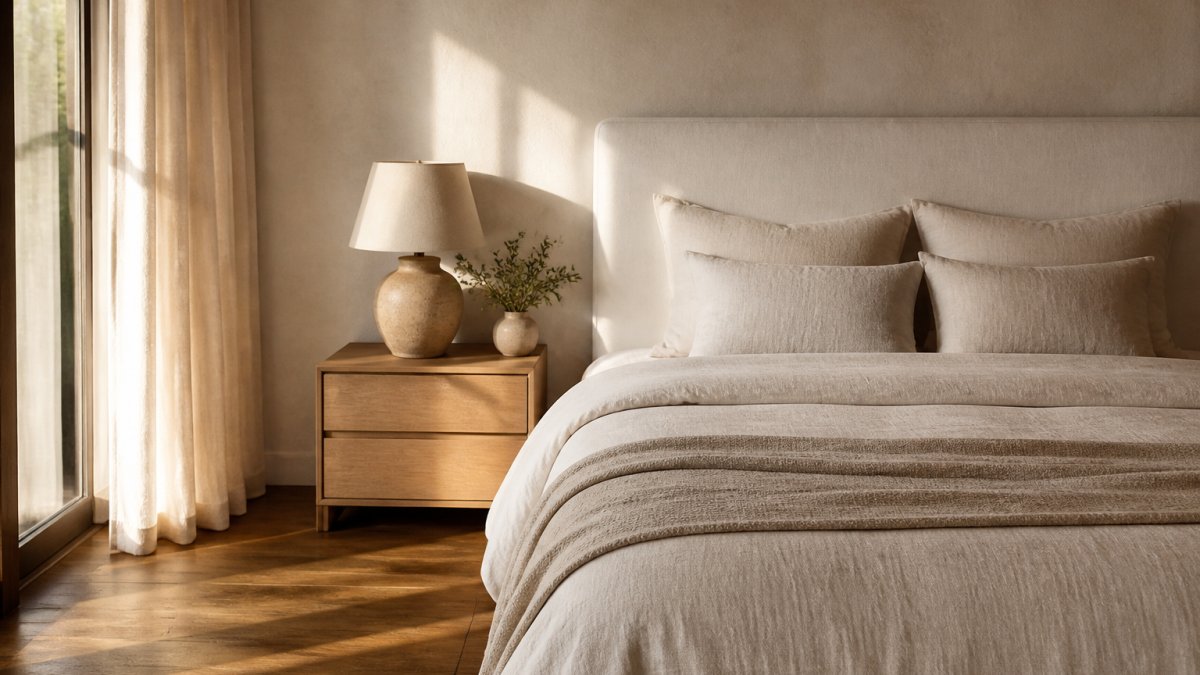
Apply the classic split to bedroom design: roughly 60 percent of the room in your base neutral, 30 percent in a secondary soft neutral, and 10 percent in a deeper accent. In practice, that means walls and large upholstery in cream or warm white, bedding and curtains in oatmeal or greige, and a single darker note in wood, metal, or a throw.
Watch out: skipping the 10 percent accent entirely is the most common mistake. A room with only light neutrals flattens out and starts to feel like a showroom rather than a calm retreat.
(/blogs/the-mix/mixing-wood-tones-guide) before you order, since the undertone of your wood decides which neutrals work beside it.3. Make a Sculptural Bed the Room's Anchor
A sculptural bed does more for a bedroom than any other single purchase.
This is where relaxed luxury and ordinary bedroom decor separate. A standard frame with a bolted-on headboard reads as furniture. A single upholstered form reads as design.
The Floradora Bed in Boucle is priced at $1,495 and is finished in a soft, durable boucle fabric shown in cream.

4. Layer Soft Textures Without the Clutter
Texture is what stops a neutral bedroom from looking unfinished. The rule we use: three textures maximum per surface, and never more than two patterns in the whole room.
Build layers in this order:
- Bedding base: washed linen or cotton in your secondary neutral.
- Mid layer: a quilted or ribbed coverlet for visual depth.
- Top layer: one chunky knit or boucle throw, folded rather than spread.
- Pillows: two large, two standard, one accent. Stop there.
Add tactile interest away from the bed with a woven piece, such as the Margarita occasional chair in woven textured fabric.
5. Get Bedroom Lighting Ideas Right at Three Heights
Good bedroom lighting ideas follow one rule: never rely on a single ceiling fixture. Layer light at three heights and the room changes character after dark.
- High: a dimmable ceiling fixture or pendant, on a warm bulb.
- Mid: wall sconces or a slim table lamp on each nightstand.
- Low: a floor lamp or a small lamp on a dresser for ambient glow.
Pair lamps with nightstands that give them room to breathe. The Golden Fizz nightstand at $995 measures 36 inches wide with a clean handleless front, which keeps the surface calm while holding a lamp, a book, and a glass of water.
6. 2026 Luxury Bedroom Design Trends Worth Following
Most 2026 trend roundups list a dozen ideas and explain none of them. The trends that actually hold up in a relaxed luxury bedroom share one trait: they are structural or tactile rather than decorative, so they age with the room instead of dating it. Here are the ones worth adopting, with the specifics that make them work.
Textured Ceilings and Limewash Walls
A flat white ceiling is the default, and it is also the fastest way to make a well-furnished room feel unfinished. In 2026, the move is a subtle plaster or limewash finish that catches light and adds depth without pattern. Limewash is breathable and repairable, and it reads as a soft wash of color rather than a painted surface. Apply it to the ceiling only, or to the ceiling and one wall, and keep the rest of the room quiet so the texture has somewhere to land.
Rounded and Sculptural Forms
Rounded headboards, pill-shaped mirrors, and curved nightstands are everywhere in 2026, and the reason is practical: curves soften the hard rectangles that dominate most bedrooms and make small rooms feel less boxed in. The trade-off is that a rounded headboard eats into usable wall space behind the bed, so measure the curve's depth before you commit. A 76-inch curved headboard, for example, projects several inches further into the room than a flat one at the same width, which matters in a room under 12 feet wide.
Hand-Crafted Wood as the Warm Counterweight
After several years of all-white everything, hand-crafted wood is back as the grounding element. Look for visible grain, joinery you can see, and finishes that show the species rather than hiding it under a heavy stain. Warm oak, walnut, and ash pair best with the soft neutrals in Section 1, and they give a pale room the one darker note the 60-30-10 split calls for.
What to Skip
Skip bold patterned accent walls, heavy drapery swags, and trend-driven metallic finishes. They date fastest, they fight the calm the rest of the room is working toward, and they are the first things a future buyer or renter will want to change. If you want pattern, put it in a single pillow or a throw rather than on a wall.
7. Small Bedrooms and Rentals: Relaxed Luxury at Any Scale
Most relaxed luxury bedroom content assumes a large primary suite. That leaves out anyone in a 10-by-12-foot bedroom or a rental they cannot modify, which is most people. The good news is that scale, not budget, is the real limiting factor, and the same principles work in a small room if you plan the layout before you buy anything.
Start With Clearance, Not Furniture
The first decision in a small bedroom is circulation, not style. A common planning rule is to keep at least 24 inches of walking space on the sides of the bed you use to get in and out, and 36 inches at the foot if a dresser or bench sits opposite. In a 10-by-12-foot room, that math usually rules out a king bed and often rules out a queen with two large nightstands.
Choose One Statement Piece and Keep the Rest Low-Profile
In a small room, the bed is almost always the statement piece. Let it carry the visual weight and keep everything else low and quiet: a low-profile platform base, a single slim nightstand, and a bench only if the clearance allows. A sculptural bed in a small room does more work than three accent pieces, because it gives the eye one place to land instead of five.
Rental-Friendly, Reversible Upgrades
Rentals rule out built-ins, wallpaper, and most hardwired lighting, but they leave plenty of room for relaxed luxury if you spend on pieces you can take with you:
- Lighting: swap the ceiling fixture for a plug-in pendant or a dimmable floor lamp on a smart plug. No wiring, full control over warmth and brightness.
- Curtains: hang a tension rod or a wide curtain rod close to the ceiling and let the panels run to the floor. This makes the room read taller and hides an ugly rental blind.
- Bedding and textiles: these are the surfaces you touch and see most, and they move with you. Spend here first.
Sleep-Supportive Design in a Small Room
Small rooms amplify light and sound, so comfort choices matter more, not less. Layer light at three heights (see Section 5) and put every bulb on a dimmer or smart plug so you can drop the room to a warm glow an hour before bed. Keep the bed away from the door if the layout allows, since a bed facing the doorway is harder to settle into.
8. Budget Tiers, Sustainable Materials, and What to Skip
Spend where the room touches you daily, and save where it does not. That is the whole budget strategy for a relaxed luxury bedroom.
| Priority | Where to spend | Where to save | Why it matters |
|---|---|---|---|
| Anchor piece | Bed frame and upholstery | Decorative pillows | The bed sets the room's tone for years |
| Lighting | Dimmable fixtures and sconces | Ceiling shade | Light quality changes how the room feels at night |
| Textiles | Bedding and curtains | Accent throws | These are the surfaces you touch and see most |
| Storage | One well-made nightstand | Extra dressers | Fewer, better pieces keep the room calm |
On materials, favor natural fibers and solid wood over veneered composites where the budget allows. They age better, repair more easily, and keep a bedroom out of the replacement cycle.
One honest limitation: handcrafted upholstery and solid wood cost more upfront than flat-pack equivalents.
Frequently Asked Questions
How do you make a bedroom look luxurious but relaxed?
Start with a calm base: soft neutral walls, a sculptural bed, and bedding in three to four tones from the same family. Relaxed luxury comes from restraint, so choose fewer, better pieces and let texture do the work. Add a curved or upholstered bed frame, layer a linen duvet with a cotton throw, and keep surfaces mostly clear. Warm lighting on dimmers finishes the look without making the room feel staged or formal.
What are the bedroom design trends for 2026?
The strongest 2026 luxury bedroom design trends are quiet luxury palettes, sculptural and rounded bed frames, textured ceilings, hand-crafted wood furniture, and coastal-inspired neutrals with warm brown accents. Layered bedding in plush textures and patterned accent walls in muted tones also appear across trend roundups. The common thread is a calm retreat that looks collected over time rather than decorated all at once.
What colors make a bedroom feel calm and luxurious?
Soft neutrals such as cream, oatmeal, taupe, and warm gray form the calmest base for a relaxed luxury bedroom. Add depth with caramel brown furniture, champagne metallics, or a moody dark accent on one wall. Coastal-inspired palettes of sand and soft blue also work well. Keep bold colors to about 10 percent of the room so the overall effect stays restful rather than busy.
How can you make a small bedroom feel luxurious?
Use a low platform bed to keep sightlines open, mount lighting on the wall instead of using floor lamps, and choose nightstands that fit the wall width exactly. A tall headboard adds height without taking floor space. Keep bedding in one tonal family and add a single textured element, such as a boucle bench or a woven rug. Mirrors and warm dimmable lighting make the room feel larger and more expensive.
A calm bedroom is a decision, not a discovery. It comes from choosing fewer pieces and choosing them well, then letting texture, light, and proportion do the rest. At Tom Collins Home, our handcrafted luxury furniture is designed in Southern California and built to last, so the anchor pieces in your room hold up long after the trend cycle moves on. Browse the collection and get updated when new pieces arrive.


