



Buy Handcrafted Solid Wood Furniture: A 2026 Guide
Table of Contents
- Why Handcrafted Solid Wood Furniture Outlasts Everything Else
- Wood Species Comparison: Cherry, Walnut, Oak, and Maple
- The Real Benefits of Solid Wood Furniture for Your Home
- How to Identify Quality Wood Furniture Before You Buy
- Sustainably Sourced Hardwoods and What Certifications Mean
- Customization, Sizing, and Made-to-Order Options
- Caring for Handcrafted Wood Tables and Furniture Long-Term
- Is Solid Wood Furniture Worth the Investment?
Last Updated: August 25, 2026
Most furniture disappoints within five years. Solid wood furniture is the exception. At Tom Collins Home, we offer a curated collection of handcrafted luxury furniture designed in Southern California. This guide covers wood species, joinery techniques, sustainability certifications, and long-term care, everything you need to make a confident, informed purchase.
The short version: not all solid wood is equal, and not all "handcrafted" labels mean the same thing.
Why Handcrafted Solid Wood Furniture Outlasts Everything Else
Handcrafted solid wood furniture outlasts mass-produced alternatives because of how it's built. Quality hardwoods combined with skilled joinery create structural integrity that engineered wood, MDF, and particle board cannot replicate. A handcrafted piece, built by an artisan who understands wood movement and grain direction, is designed to flex slightly with seasonal humidity changes rather than crack or warp.
Joinery Techniques That Define Heirloom Quality
The most telling sign of quality construction is the joinery.
Mortise and tenon joints lock two pieces of wood together with a projecting tongue (tenon) fitted into a cavity (mortise). When properly fitted and glued, this joint is stronger than the wood around it. You'll find it in chair legs, table aprons, and frame connections on quality pieces.
Dovetail joints interlock at an angle, creating a mechanical connection that resists pulling apart. Hand-cut dovetails are a reliable signal that a craftsperson, not a machine, built the piece.
Joinery quality is something you can verify before buying. Ask the maker directly and pull out a drawer to look at the corners. If you see dovetails, you're looking at a piece built to last.
Kiln-Dried Hardwoods and Why They Matter
Kiln-dried wood has had its moisture content reduced in a controlled environment before being milled. This matters because wood that retains excess moisture will continue to dry and shrink after construction, causing joints to loosen, surfaces to crack, and drawers to stick. Quality furniture makers use hardwoods dried to a moisture content appropriate for interior environments.
Wood Species Comparison: Cherry, Walnut, Oak, and Maple
Choosing a wood species affects color, grain pattern, hardness, and how the piece ages over time.
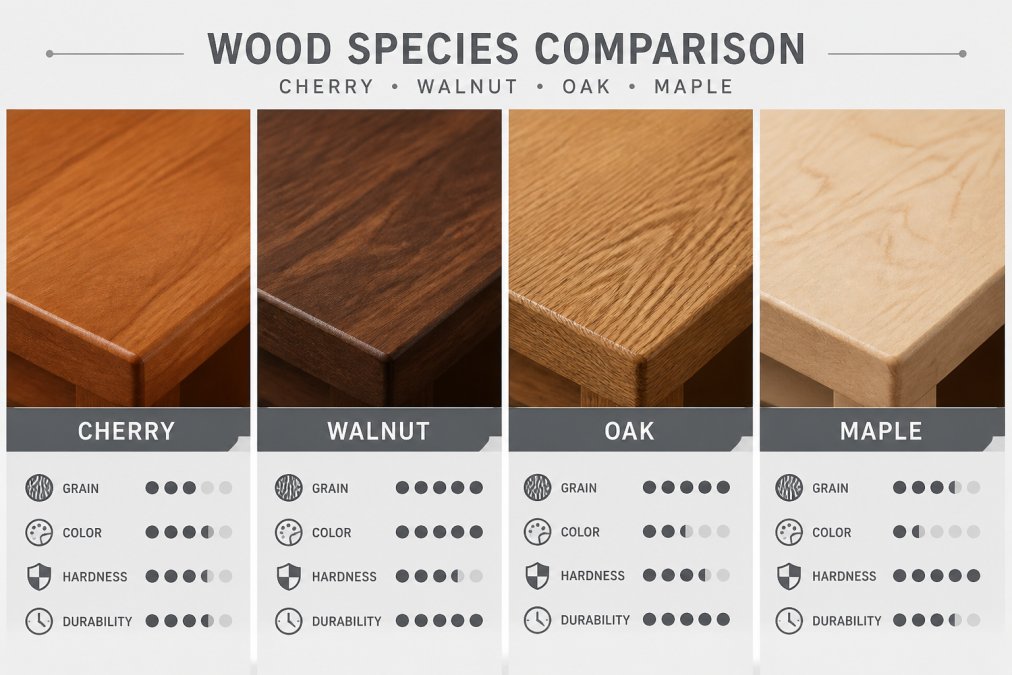
Grain Pattern and Color Across Species
| Species | Color Profile | Grain Character | Hardness | Best Known For |
|---|---|---|---|---|
| Cherry | Warm reddish-brown, deepens with age | Fine, straight grain | Medium | Classic dining and bedroom furniture |
| Walnut | Rich chocolate brown | Bold, open grain | Medium-hard | Statement dining tables, accent pieces |
| Oak | Light tan to golden brown | Pronounced, cathedral grain | Hard | High-traffic pieces, traditional styles |
| Maple | Creamy white to light amber | Tight, subtle grain | Very hard | Contemporary designs, kitchen furniture |
Cherry darkens to a deep, warm tone over years of light exposure, developing a patina that makes each piece unique. Walnut is dramatic from day one, with a grain pattern that commands attention. Oak's pronounced grain and hardness make it the workhorse of the four. Maple's tight grain takes stain evenly and sands to an exceptionally smooth finish, making it ideal for contemporary furniture.
Matching Wood Species to Each Room
- Dining room: Walnut and oak handle daily punishment well. Walnut's visual weight anchors formal spaces; oak suits casual, family-oriented rooms.
- Bedroom: Cherry's warmth and fine grain create intimacy.
- Living room: Maple works well for lighter, cleaner aesthetics. Walnut makes an exceptional statement piece.
- Home office: Oak's durability resists surface denting from daily use.
The Real Benefits of Solid Wood Furniture for Your Home
Solid wood can be repaired in ways engineered wood cannot. A scratch on solid wood can be sanded and refinished, restoring the surface to near-original condition. That repairability is a form of longevity rarely discussed.
Solid wood also improves with age. The patina that develops over decades is not a defect, it's the material expressing its history. A 40-year-old piece of well-maintained walnut is more beautiful than a new one.
There's also an environmental argument. A solid wood piece lasting 50 years represents better lifecycle impact than three or four replacement pieces over the same period. Responsibly sourced hardwoods from well-managed forests can be a genuinely renewable material.
How to Identify Quality Wood Furniture Before You Buy
Quality wood furniture reveals itself through specific physical tests you can perform in under two minutes.
Check the weight. Solid hardwood is heavy. If a piece feels surprisingly light, it likely contains hollow sections, MDF, or particle board.
Look at grain continuity. On solid wood, the grain pattern flows continuously. On veneered MDF, the pattern often repeats at regular intervals or shows seams.
Examine drawer construction. Open every drawer and look at the corners. Dovetail joints signal quality. Staples or metal brackets signal the opposite.
Check the underside and back. Quality makers finish the parts you don't see. Raw particle board visible from the back of a cabinet is a red flag.
Red Flags That Signal Poor Construction
Watch for these warning signs:
- Veneer lifting at edges or corners
- Drawers that stick or don't close flush
- Wobble in chairs or tables that can't be adjusted
- Plastic corner blocks instead of wood blocks or proper joinery
- Stain that looks painted on rather than penetrating the grain
If a piece fails two or more of these checks, move on regardless of appearance.
Sustainably Sourced Hardwoods and What Certifications Mean
The Forest Stewardship Council certification standards (FSC) is the most rigorous third-party certification for wood products. FSC-certified wood comes from forests managed to environmental, social, and economic standards. When a furniture maker specifies FSC-certified hardwoods, that claim is independently verified.
The Sustainable Forestry Initiative (SFI) is another certification common in North American markets. Both are meaningful; FSC is generally considered the more stringent standard.
A complete picture of sustainability includes the wood source, finishing products, and manufacturing process. Artisan makers with direct relationships to lumber suppliers offer supply chain transparency worth asking about.
Customization, Sizing, and Made-to-Order Options
One of the strongest arguments for buying from an artisan maker is the ability to specify dimensions and finishes for your actual space. Standard furniture dimensions are designed for average rooms. Made-to-order furniture solves this directly.
Customization options typically include:
- Dimensions: Width, depth, and height adjusted to your specifications
- Wood species: Choice of cherry, walnut, oak, maple, or other hardwoods
- Finish: Natural oil, hand-rubbed wax, or catalyzed lacquer in various stain tones
- Hardware: Drawer pulls, hinges, and leg styles
- Configuration: Extension leaf options for tables; interior shelf arrangement for storage
Tom Collins Home offers made-to-order options across its collection, designed in Southern California with the flexibility to fit real homes. For current customization options and lead times, reach out directly.
Caring for Handcrafted Wood Tables and Furniture Long-Term
The single most important factor in solid wood furniture care is managing moisture. Rapid humidity changes cause wood to expand and contract, stressing joints and causing surface cracking. Maintaining consistent indoor humidity, roughly 35-55% relative humidity, does more for longevity than any product you can apply.
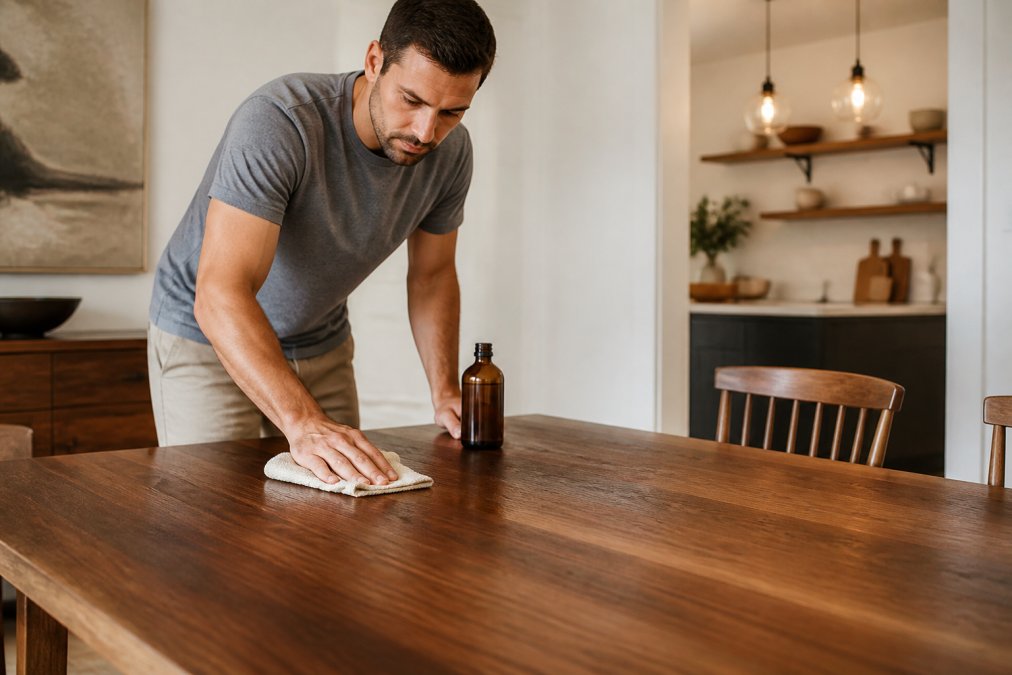
Cleaning and Conditioning Routines
For day-to-day cleaning, a slightly damp cloth followed immediately by a dry cloth is sufficient. Avoid silicone-based polishes, which build up and interfere with future refinishing. Avoid ammonia-based cleaners, which strip natural oils.
For oiled or waxed finishes, periodic conditioning with food-safe oil or paste wax maintains the surface. Condition when the surface looks dull or feels slightly rough. For lacquered surfaces, cleaning with a damp cloth is sufficient.
Repairing Minor Scratches and Surface Damage
Minor scratches on solid wood are not permanent. For light scratches on an oiled finish, rubbing with matching oil and fine steel wool (0000 grade) along the grain will blend the scratch. For deeper scratches, color-matched wood filler applied and sanded flush, followed by a fresh coat of finish, restores the surface.
Match the repair to the finish type. An oil-finished piece should be repaired with oil; a wax-finished piece with wax. For significant damage, professional refinishing is worth the cost. Quality solid wood furniture can be fully stripped and refinished multiple times over its life.
Is Solid Wood Furniture Worth the Investment?
Solid wood furniture is worth the investment when you intend to keep a piece for a decade or more. The honest comparison isn't solid wood versus a cheaper alternative at the same price, it's solid wood versus replacing a cheaper piece two or three times over the same period. When you factor in replacement costs and disposal, the economics of quality solid wood become considerably more favorable.
Well-made solid wood furniture from respected makers holds its value in ways flat-pack and engineered wood furniture never does. Antique solid wood pieces regularly sell for more than their original price.
The most sustainable purchase is the one you only make once. Furniture you genuinely love, that fits your home precisely, tends to be maintained better and kept longer. That emotional dimension is part of the investment case.
Frequently Asked Questions
Q: Is it worth buying solid wood furniture instead of engineered alternatives?
A: Solid wood furniture is worth the investment for most homeowners who plan to stay in a space long-term. Unlike particleboard or MDF-core pieces, solid wood can be refinished, repaired, and passed down across generations. The upfront cost is higher, but the per-year cost over a 30- to 50-year lifespan often works out lower than replacing budget furniture every five to eight years. For heirloom quality and structural integrity, handcrafted solid wood furniture is the clear choice.
Q: How can you tell if furniture is solid wood or veneer?
A: Check the edges and undersides first. Solid wood shows continuous grain that wraps around corners; veneer shows a thin surface layer with a different core material visible at cut edges. Knock on the surface, solid wood produces a dense, low sound, while hollow-core or particleboard pieces sound noticeably lighter. Look at joinery points: dovetail joints and mortise and tenon construction signal genuine craftsmanship. Weight is another indicator, solid hardwood pieces are substantially heavier than engineered alternatives of the same size.
Q: Does anyone still make solid wood furniture in the USA?
A: Yes. American-made, handcrafted solid wood furniture is still produced by artisan workshops and curated brands. The market has actually grown as more buyers move away from mass-produced imports. Brands like Tom Collins Home design and curate pieces built with sustainably sourced hardwoods, focusing on construction methods, mortise and tenon, dovetail joints, that define genuine durability. Shopping American-made also supports domestic woodworking trades and reduces the supply-chain uncertainty common with overseas manufacturers.
Q: What wood species is best for dining tables and bedroom furniture?
A: Walnut and cherry are top choices for dining tables because their dense grain resists denting and their warm tones deepen beautifully over time. Oak is exceptionally durable and suits high-traffic pieces like dining tables and bedroom dressers. Maple, the hardest of the common furniture hardwoods, works well for tabletops that see daily use. The right species depends on your aesthetic preference, the room's existing tones, and how much natural patina you want the piece to develop over the years.
Choosing where to buy matters as much as knowing what to buy. Tom Collins Home offers a curated collection of handcrafted luxury furniture designed in Southern California, built from quality hardwoods with the joinery and finishing standards this guide describes. Every piece is designed to last, not as a marketing claim, but as a construction standard. Explore the collection and get updated on new arrivals and made-to-order options at Tom Collins Home.
This article was written using GrandRanker


